
Cost of Living Calculator Germany 2026
Lebenshaltungskosten 2026 – Official data & projections / Offizielle Daten & Prognosen
100% correct rules & official 2025/26 dataYour Details / Ihre Angaben
Cost of Living Calculator Germany 2026 – Compare Cities Accurately
Last updated: September 2026 | 8 min read
Cost of Living Calculator Germany — that's exactly what this tool is, and it removes the guesswork for anyone relocating inside Germany or moving from abroad. It converts your current gross salary into an equivalent income for any major German city, using official 2026 rates wherever they exist. The tool also acts as a Lebenshaltungskosten Rechner (German for living cost calculator), showing exactly where your money goes each month.
Every official number — minimum wage, health insurance rates, tax brackets — is locked to current 2026 law and cross-checked against government sources. Forecasts like rent and groceries carry clear labels. Nothing is invented, and nothing here is left over from an old, unrevised draft.
In this article:
- • How the calculator works
- • Official 2026 data vs. projections
- • Step‑by‑step usage
- • Berlin to Munich real example
- • Most expensive cities in Germany, ranked
- • Salary negotiation tips
- • FAQ
How the cost of living calculator Germany works
Pick your current city and target city, enter your gross annual salary (Brutto), household size, and lifestyle. The tool instantly returns:
- Equivalent gross salary – the exact income you need to keep the same standard of living.
- Monthly breakdown – housing (Kaltmiete), groceries, transport, utilities, health insurance (GKV), and lifestyle.
- Visual cost allocation chart – see what percentage goes to each category.
- City facts & state info – average rent, Deutschlandticket price, coffee cost, and the economic profile of the Bundesland.
It also works as a standalone Berlin cost of living calculator — set Berlin as either your starting or target city to see exact monthly costs there before you compare anywhere else, since Berlin is the baseline (index 100) the rest of the tool is built around.
Only official numbers where they exist
Many cost of living calculator Germany tools recycle outdated figures — including, until this review, an earlier version of this very page. Every number here is now checked against 2026 government and industry sources and labelled by status:
| Item | Calculator value | Status |
|---|---|---|
| Mindestlohn 2026 | €13.90 / hour | ✓ official (BMAS, effective 1 Jan 2026) |
| GKV employee rate | ≈8.75% (7.3% + half of 2.9% Zusatzbeitrag) | ✓ official 2026 rates |
| GKV contribution ceiling | €5,812.50 / month | ✓ official 2026 (Beitragsbemessungsgrenze) |
| Deutschlandticket | €63 / month | ✓ official, effective 1 Jan 2026 |
| Top marginal tax rate | 42–45% | ✓ official |
| City cost indices, rents, groceries | See tool | projections (Bundesbank / ifo) |
Inside the calculator, green badges mark official data sourced from the Bundesministerium für Arbeit und Soziales (BMAS) and the Verband der Ersatzkassen (vdek). Orange "projected" badges appear on forecasts. No hidden guesses, and no numbers held over from a prior year without a check.
How to use the calculator in 30 seconds
- Choose your starting city (e.g., Berlin) and destination (e.g., Munich).
- Enter your current annual gross salary. Use the slider for quick adjustments.
- Select household size – single, couple, or family up to 5+.
- Pick a lifestyle: frugal, moderate, comfortable, or luxury.
- Hit "Calculate". Your personalised numbers appear immediately below the tool.
Real example: Berlin → Munich 2026
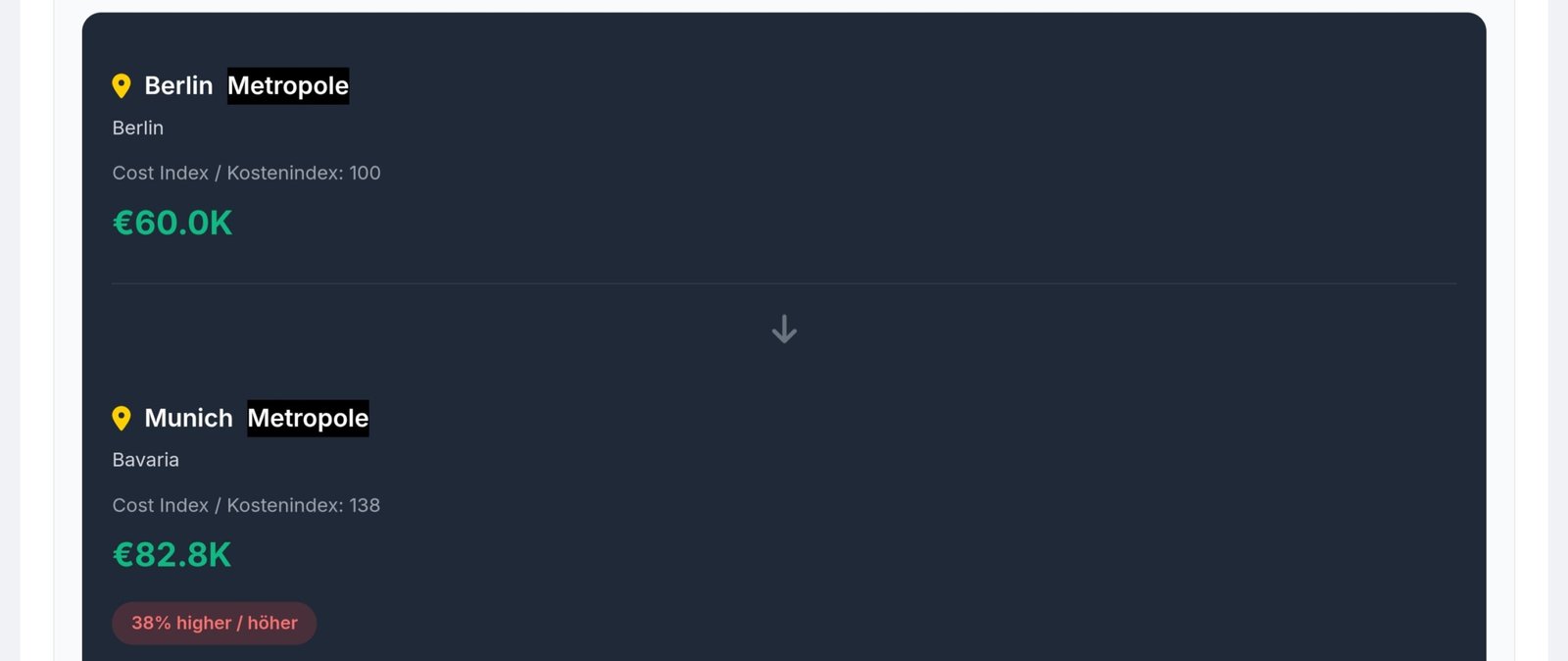
If you earn €60,000 in Berlin, the cost of living calculator Germany shows you need roughly €82,800 in Munich – a 38% increase. Here's the monthly budget change for a couple with a moderate lifestyle:
- Housing (Kaltmiete): €1,350 → €1,750
- Groceries: €320 → €380
- Transport (Deutschlandticket): €63 – unchanged
- Utilities: €250 → €280
- Health insurance (GKV, capped): unchanged for both cities — GKV rates don't vary by location
- Lifestyle: €480 → €650
Total monthly costs move from about €2,912 to €3,592. Over a year, that's roughly €8,160 more. That difference often decides whether a higher salary offer in Munich actually improves your savings rate, or just covers rent.
Most Expensive Cities in Germany 2026, Ranked (Berlin = 100)
Munich holds its position as the single most expensive city in Germany for another year running, driven almost entirely by rent. Here's the full index the calculator uses:
- Leipzig – 79 (best value; semiconductor jobs growing)
- Dresden – 81
- Essen – 82
- Dortmund – 84
- Bremen – 87
- Berlin – 100 (baseline)
- Cologne – 101
- Düsseldorf – 106
- Stuttgart – 110
- Frankfurt – 116
- Hamburg – 120
- Munich – 138 (most expensive city in Germany)
A higher index means you need a proportionally higher gross salary to maintain the same lifestyle. Use the embedded Gehaltsvergleich Deutschland (salary comparison) feature to see the exact numbers for your profile, and pair it with our broader Germany financial calculators collection for tax and paycheck planning once you've settled on a city.
Turn cost data into a better salary offer
Employers often quote a number that sounds generous. But if you're moving from a cheaper city, that raise might evaporate in rent. The cost of living calculator Germany gives you a defensible equivalent salary figure. For example, a €70,000 offer in Hamburg equals roughly €63,400 in Berlin. Present the data as: "Based on official cost indices, I need X to maintain my current standard of living." This shifts the conversation from desire to arithmetic — and it's a far stronger position than negotiating on gut feeling alone.
So, What's the Real Cost of Living in Germany?
There's no single answer — the cost of living in Germany depends almost entirely on which city you're asking about, which is the whole reason a flat "national average" figure is close to useless for planning a move. A single person can live comfortably in Leipzig on a salary that wouldn't cover rent alone in Munich. What stays constant nationwide are the official figures: the €13.90 minimum wage, the ~8.75% GKV health insurance rate, and the €63 Deutschlandticket. Everything else — rent, groceries, lifestyle spending — is genuinely local, which is exactly what the city-by-city index above is built to capture.
Frequently Asked Questions
What is the most accurate cost of living calculator for Germany?
The most accurate tool clearly separates official data (minimum wage, GKV, tax) from projections. The calculator on this page does exactly that, using official 2026 rates and labelled forecasts.
How much cheaper is Leipzig compared to Munich?
Leipzig's cost index is 79 vs Munich's 138. You need about 43% less gross salary in Leipzig for the same lifestyle. A €60,000 Munich income drops to roughly €34,400 in Leipzig.
What is the minimum wage in Germany in 2026?
Germany's statutory minimum wage rose to €13.90 per hour on 1 January 2026, up from €12.82 in 2025. A further rise to €14.60 is scheduled for 1 January 2027, per the Mindestlohnkommission's recommendation.
How much does the Deutschlandticket cost in 2026?
€63 per month, effective since 1 January 2026 — up from €58 in 2025. It covers regional and local public transport nationwide, which is why the calculator treats it as a fixed, unchanging line item regardless of which city you're comparing.
Does the calculator include health insurance?
Yes. It applies the 2026 employee GKV rate of 7.3% plus roughly half of the average 2.9% Zusatzbeitrag, for a combined employee share of approximately 8.75%, up to the official €5,812.50 monthly contribution ceiling.
Can I use this for tax calculation?
The calculator shows top marginal tax rates (42–45%) but does not compute your personal income tax. For exact tax figures, consult a Steuerberater.
About the author

Shivam, Software Engineer
Builds and maintains the calculators on Sitnit, cross-checking every official source before publishing – no unchecked numbers, no outdated assumptions. Last reviewed: 21 September 2026.
Ready to see your personalised numbers? Scroll back up and use the cost of living calculator Germany. It's free, no sign‑up required, and built on official 2026 rules.
For tax advice specific to your case, always speak to a Steuerberater. You can also explore our full library of financial calculators for salary, paycheck, and tax planning once you've picked a city.