
Face Shape
Detector
Discover your face shape instantly using photo analysis or our guided quiz, then unlock personalised style tips.
Drop your photo here
Upload a clear, front-facing photo with good lighting.
No filters. Hair pulled back for best results.
Also Possible
Style Insights
Take the Precision Quiz →
Precision Face Shape Quiz
Answer 7 carefully crafted questions about your facial features. This method gives the most accurate result — no photo needed.
Style Insights
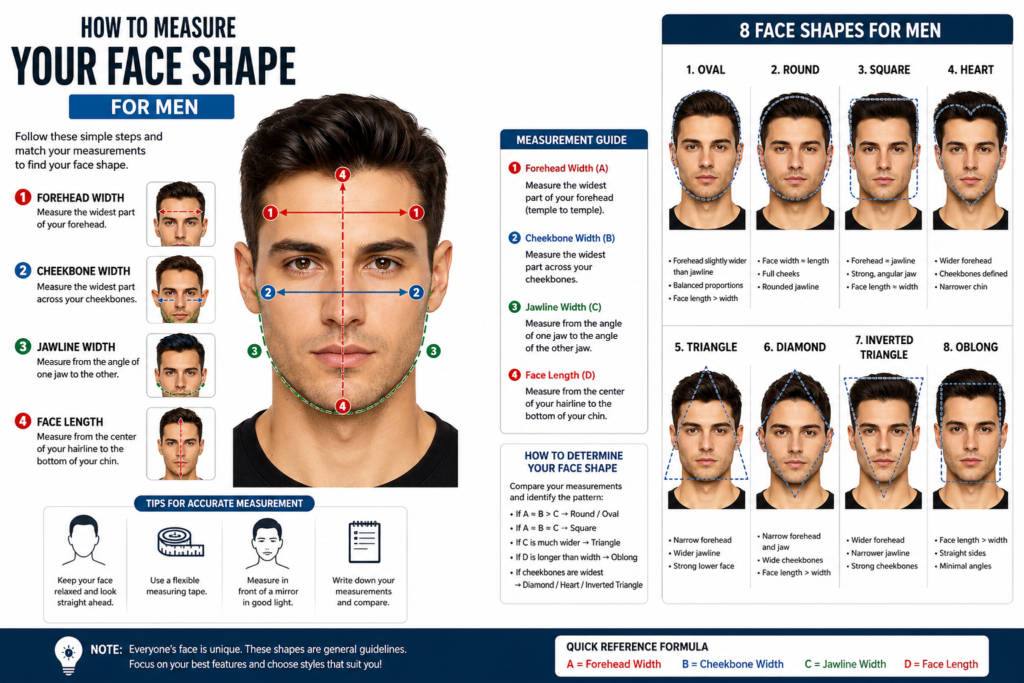
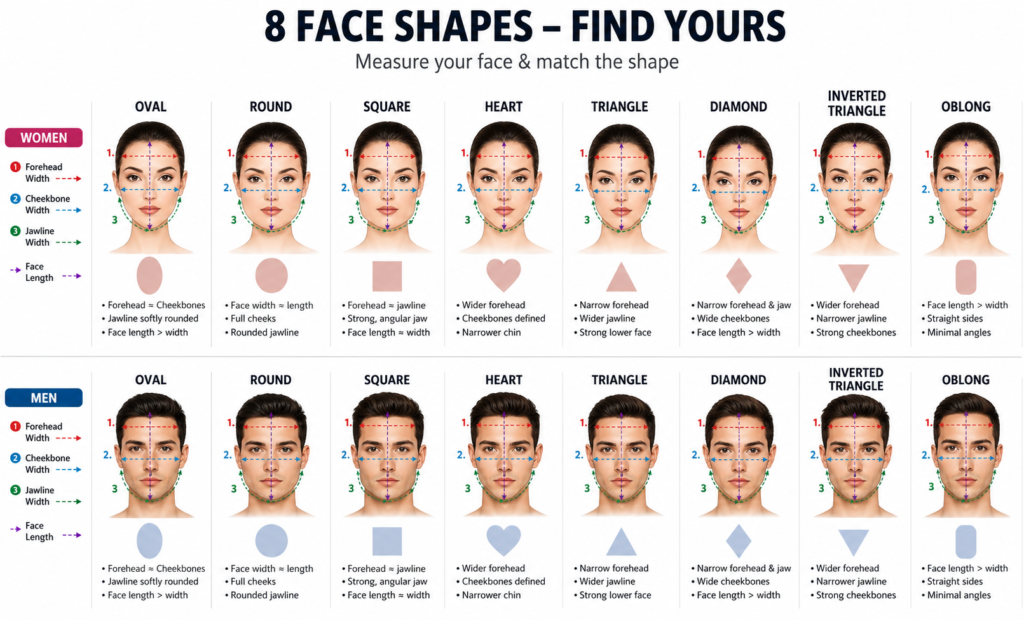
Face Shape Detector: The Only Guide You Need to Find Your Face Shape
If you've ever stood in front of a mirror wondering why a haircut looked great on someone else but terrible on you, the answer almost always comes down to one thing — face shape. This free face shape detector takes the guesswork out of the equation with two ways to check: instant AI photo analysis, or a 100% accurate guided quiz that most other detectors don't offer at all. Get a clear, reliable result in under two minutes.
Quick Answer: The 8 Face Shapes at a Glance
| Face Shape | Defining Trait | Widest Point |
|---|---|---|
| Oval | Balanced, slightly longer than wide | Cheekbones |
| Round | Width and length nearly equal, soft curves | Cheeks |
| Square | Strong angular jaw, broad forehead | Equal at forehead, cheeks, jaw |
| Rectangle / Oblong | Long face, straight even sides | Equal at forehead and jaw |
| Heart | Wide forehead tapering to a narrow chin | Forehead |
| Diamond | Dramatic, narrow forehead and chin | Cheekbones |
| Triangle | Wide jaw, narrow forehead | Jawline |
| Inverted Triangle | Very wide forehead, narrow pointed chin | Forehead |
Not sure which one is yours? Scroll to the tool above and get your exact result in under two minutes.
This guide walks you through everything: how face shape detection actually works, what each of the eight face shapes looks like, and how to use your result to make genuinely smarter decisions about your hair, glasses, and makeup.
Photo AI or Quiz? Two Ways to Find Your Face Shape
Most face shape tools online only offer one method — upload a photo and hope the lighting cooperates. This tool gives you a choice, because each method has a genuine advantage depending on what you need.
📸 AI Photo Detection
Upload a front-facing photo and the AI analyses your facial landmarks — forehead, cheekbones, jawline, and face length — in seconds. Returns a confidence-scored result so you know how certain the match is. Best when you want an instant answer and have a clear, well-lit photo on hand.
📝 Guided Quiz
Answer seven questions about your own facial features and measurements for a result based on direct observation rather than image processing. Because it isn't affected by lighting, angle, or photo quality, the quiz method gives a 100% accurate result every time — no confidence percentage needed.
What Is a Face Shape Detector and How Does It Work?
A face shape detector is a tool — either AI-powered, photo-based, or quiz-based — that analyses the proportions of your face and classifies it into one of several recognised categories.
The most accurate tools look at four key measurements:
- Forehead width — the widest point above your eyebrows
- Cheekbone width — the widest point across your cheeks
- Jawline width — the widest point of your jaw
- Face length — from the centre of your hairline to the tip of your chin
The relationship between these four measurements determines your face shape. An oval face has a face length roughly one and a half times its width, with cheekbones as the broadest point. A square face has nearly equal measurements across all four points with a sharp, angular jaw.
Our tool offers two detection methods:
- Photo upload — upload a front-facing photo and the AI analyses your facial geometry and returns a confidence-scored result
- Guided quiz — answer seven questions about your facial features for a 100% accurate result based on your own observations
Both take under two minutes to complete.
The 8 Face Shapes Explained
Most style guides recognise between seven and ten face shapes. Here are the eight most common, what they look like, and what makes each one unique.
1. Oval Face Shape
Often called the "ideal" face shape for styling purposes, an oval face is longer than it is wide, with the forehead slightly wider than the jawline and gently curved cheekbones. The face tapers softly toward the chin without sharp angles.
If you have an oval face, almost any hairstyle, glasses frame, or makeup technique works in your favour. The proportions are already naturally balanced, so the goal is simply to maintain that harmony rather than correct anything.
2. Round Face Shape
A round face is roughly as wide as it is long. The cheeks are full and prominent, the jawline is soft with no sharp corners, and the forehead curves gently at the hairline. The overall silhouette is circular rather than angular.
Round faces benefit most from styles that add length and reduce the appearance of width — long layers, high-volume crown styles, and angular glasses frames are classic recommendations.
3. Square Face Shape
A square face has a broad, flat forehead, strong cheekbones, and a defined angular jawline roughly the same width as the forehead. The sides of the face run nearly parallel from the temples to the jaw, giving a powerful, structured look.
Softening the jaw is usually the style goal — waves, layered cuts, and round glasses frames all help. Square faces also tend to age particularly well because strong bone structure remains defined over time.
4. Rectangle Face Shape (Oblong)
A rectangular or oblong face is noticeably longer than it is wide, with a similar width across the forehead, cheekbones, and jaw. The sides are fairly straight, giving an elongated appearance.
Styles that add horizontal width — shoulder-length cuts, side-swept bangs, wide glasses frames — create a more balanced proportion.
5. Heart Face Shape
A heart-shaped face is widest at the forehead, narrows through the cheekbones, and tapers to a narrow or pointed chin. This creates the classic inverted-triangle silhouette.
The style goal for heart faces is usually to balance the wider forehead with volume lower on the face — chin-length waves, off-centre partings, and bottom-heavy glasses frames all work well.
6. Diamond Face Shape
Diamond-shaped faces are widest at the cheekbones, with a narrow forehead and narrow chin. This creates a dramatic, angular appearance with strong mid-face definition. It is one of the less common face shapes and is often considered striking.
Hairstyles that add width at both the forehead and chin — side-swept fringes, chin-length bobs — are most flattering.
7. Triangle Face Shape
A triangle face shape — sometimes called a pear-shaped face — is widest at the jawline and narrows toward the forehead. The jaw is the dominant feature, with the forehead noticeably narrower than the lower face.
Styles that draw attention upward and add volume at the crown help balance the wider jaw. Cat-eye glasses frames also work effectively.
8. Inverted Triangle Face Shape
The inverted triangle face shape is the opposite of the triangle — a very wide, broad forehead tapering to a narrow, sometimes pointed chin. Similar to the heart shape but more linear, with the narrowing happening more gradually.
Adding volume below the cheekbones — chin-length styles, waves at the ends — helps counterbalance the broader upper face.
How to Get the Most Accurate Result
The single most common reason people get an inaccurate face shape result — whether from a tool, a quiz, or a stylist — is poor conditions during measurement or upload. Here is what actually matters.
For Photo Upload
- Use a recent, well-lit photo taken in natural daylight
- Face the camera directly — no tilting, turning, or looking down
- Pull your hair completely back away from your face
- Remove glasses before uploading
- Avoid photos with heavy filters, heavy makeup, or unusual lighting
For the Quiz
- Stand in front of a well-lit mirror before answering
- Look straight ahead, not at an angle
- If you have a soft tape measure, measuring your forehead, cheekbones, jaw, and face length will give the most precise answers
- Answer based on your natural features, not what you wish your measurements were
Why Knowing Your Face Shape Actually Matters
The face shape concept is rooted in the principle of visual balance — the idea that certain proportions are perceived by the human eye as harmonious, and that styling choices can either work with or against your natural bone structure.
Hairstyles
A hairstyle that visually elongates a round face or softens a square jaw is not making you look "more like" an oval face. It is working with light, shadow, and volume to draw the eye in a way that creates the impression of balance. Understanding your face shape means you can walk into a salon with genuine knowledge rather than just a celebrity photo and a hope.
Glasses Frames
Glasses sit directly on your face and command immediate visual attention. The right frame shape can soften a strong jaw, add definition to a round face, or balance a prominent forehead. The wrong frame can do the exact opposite. Knowing your face shape makes glasses shopping dramatically more efficient — and far less expensive in trial and error.
Makeup Contouring
Contouring and highlighting are essentially the art of using light and shadow to adjust the apparent shape of the face. A round face is contoured differently to a square face, which is contoured differently to an oblong face. Your face shape is the foundation of any contouring technique, and tutorials that ignore this tend to produce inconsistent results.
Accessories and Necklines
Face shape also influences which earring shapes are most flattering, which collar styles work best, and even which hat styles suit you. Angular faces often pair better with rounded accessories. Round faces often look better with angular or geometric details.
Face Shape vs. Head Shape: What Is the Difference?
Face shape refers to the visible, soft-tissue contours of your face as seen from the front — influenced by your cheekbones, jaw, and the width of your forehead. This is what hairstylists and makeup artists work with.
Head shape refers to the underlying bone structure of your skull, including the back and sides of your head. Head shape matters most for very short haircuts — buzz cuts, shaved styles, and closely cropped cuts — where the back of the head is visible.
Most face shape tools, including this one, analyse face shape rather than head shape. For very short styles, it is worth considering both.
Can Your Face Shape Change Over Time?
Yes — though slowly. Several factors influence how your face shape appears as you age:
- Fat distribution changes significantly with age. The full, prominent cheeks of a round face in your twenties may shift toward a more oval or heart-shaped appearance in your forties as facial fat redistributes or reduces.
- Bone density changes are gradual but real. The jawbone can change shape slightly over decades, affecting the definition of facial features.
- Skin laxity affects how the lower face appears. As skin loses elasticity, the jawline can become less defined, softening an angular face shape.
- Weight fluctuations affect the distribution of facial fat, which can make a face appear rounder or more angular.
This means the face shape you identified at 22 may not be the same shape you have at 45 — and it is worth re-checking periodically, especially before a significant style change.
Common Mistakes When Identifying Your Face Shape
| Mistake | Why It Happens | How to Fix It |
|---|---|---|
| Looking at their face at an angle | Most selfies are slightly tilted | Use a mirror, face straight ahead |
| Confusing desired shape with actual shape | Emotional attachment to certain shapes | Measure objectively; use the quiz |
| Using an old or edited photo | Filters and older photos distort proportions | Use a recent, unfiltered, well-lit photo |
| Overthinking it | Many faces fall between two categories | Read advice for adjacent shapes — it overlaps significantly |
| Thinking one shape is better | Cultural associations with certain shapes | Every face shape has a rich range of flattering styles |
Using Your Results: A Practical Next Step
Once you know your face shape, the most useful thing you can do is apply the information to a real decision you are already making. If you have a hair appointment coming up, bring the style suggestions from your result. If you are shopping for glasses, use your result to filter by recommended frame shapes before you start trying anything on.
The goal of a face shape detector is not just identification — it is actionable self-knowledge.
Frequently Asked Questions
What's my face shape?
The fastest way to find out is to use the AI photo detector or guided quiz on this page — both take under two minutes. Manually, compare your forehead width, cheekbone width, jawline width, and face length: if they're all similar, you likely have a round or square face; if your face is noticeably longer than it is wide, you likely have an oval or oblong shape.
Is there a face shape calculator I can use without a photo?
Yes — the guided quiz on this page works as a photo-free face shape calculator. It asks seven questions about your measurements and features and returns a 100% accurate result, which is useful if you'd rather not upload an image.
How accurate is an AI face shape detector?
It depends on the method. Photo-based AI detection is highly useful but not perfect — lighting, angle, and image quality all affect the result. That is why this tool shows a confidence percentage rather than claiming 100% accuracy for photo uploads. The quiz method gives a fully accurate result every time.
What is the rarest face shape?
The diamond face shape is generally considered the rarest, characterised by a very narrow forehead and chin with dramatically wide cheekbones. The inverted triangle is also relatively uncommon.
Can I have more than one face shape?
Most faces have a dominant shape with secondary characteristics from another shape. The tool shows your primary shape along with possible secondary matches for this reason.
Is face shape determined by genetics?
Bone structure is strongly influenced by genetics. However, facial fat distribution, muscle development, and skin elasticity also play a significant role — and these can be affected by lifestyle, age, and weight changes.
Does face shape analysis apply to all genders?
The eight face shapes apply to all genders. Style recommendations differ — for men, angular shapes are often emphasised rather than softened — but the shape identification process is the same.
What face shape do most people have?
Oval is generally considered the most common face shape, followed by round and square. Distribution varies across different ethnic and geographic groups.
Should I use the photo option or the quiz to determine my face shape?
Use the photo option for a quick, instant result. Use the quiz if you want 100% accuracy or want to understand your facial features in more detail. The quiz takes about two minutes and is always more reliable than photo-based analysis, since it isn't affected by lighting or camera angle.
My result shows I am between two shapes. Which advice should I follow?
Follow the advice for both shapes and apply whatever resonates. Adjacent shapes have significantly overlapping style guidance, so you will not go wrong with either.
More AI Personal Care Tools
- Hairstyle recommendations for your face shape — personalised cuts and styles matched to your face shape result
- Find glasses frames that suit your face — AI-powered frame recommendations based on your facial proportions
- Discover your eye shape — identify your eye shape for more targeted makeup and style advice
- Analyse your skin tone — find your undertone and get colour-matched style recommendations
- Explore all AI personal care tools — the full suite of free AI beauty and style tools on SitNit
Sources
- Research on facial symmetry and attractiveness — peer-reviewed study via PubMed (National Library of Medicine)
- How the face changes with age — American Academy of Dermatology
- How to measure your face shape at home — Vogue beauty guide