
Skin Tone
Detector
Discover your skin tone and undertone instantly — then unlock your perfect colours for clothing, makeup, hair, and accessories.
Drop your photo here
Upload a clear photo in natural lighting — no filters, no heavy makeup.
A bare-face or light-makeup selfie gives the most accurate result.
Skin Tone & Undertone Quiz
Answer 6 questions about your natural features — vein colour, sun reaction, and jewellery preference. This method gives a 100% accurate undertone and skin tone result.
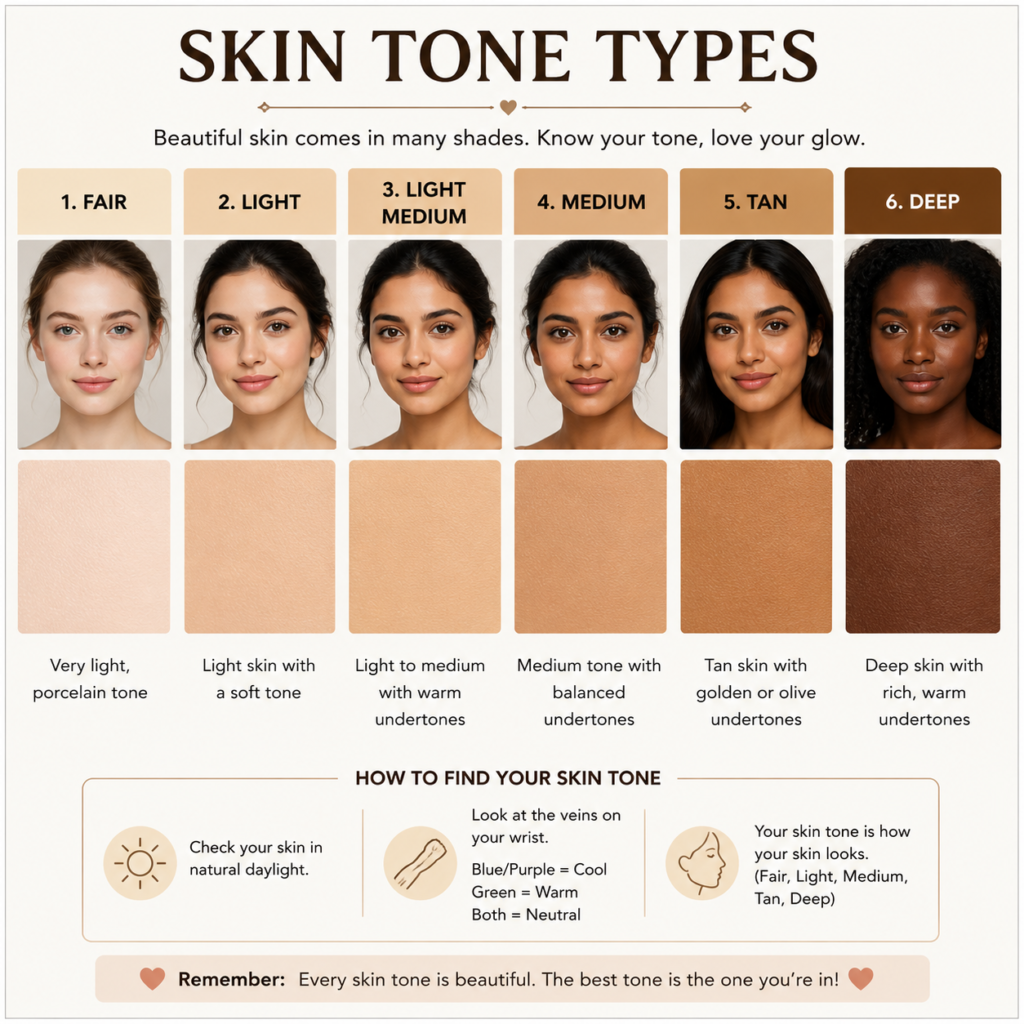
Skin Tone Detector: The Complete Guide to Finding Your Skin Tone and Undertone
Most people spend years — sometimes decades — buying the wrong foundation, choosing clothing colours that make them look tired, and wondering why certain colours photograph beautifully on others but fall flat on them. The answer almost always traces back to one thing: they have never accurately identified their skin tone and undertone.
A skin tone detector changes this. By analysing the key characteristics of your complexion — surface colour, undertone, and depth — it maps you to a precise colour profile and tells you exactly which colours will enhance your natural appearance. This guide goes further than any surface-level advice you have read before. It explains the science, the method, the common mistakes, and the practical applications that actually change how you shop, dress, and do your makeup.
Skin Tone vs. Undertone — The Distinction That Changes Everything
This is the single most important concept in colour analysis, and it is the one most guides get completely wrong by conflating two separate things. Understanding the difference between skin tone and undertone is not a technicality — it is the entire foundation of finding colours that genuinely suit you.
What Skin Tone Actually Means
Skin tone is the surface colour of your skin — the visible depth and hue you see when you look in the mirror. It is influenced by melanin levels, sun exposure, blood circulation, and age. Skin tone exists on a spectrum from very fair to very deep and changes throughout your life based on sun exposure, health, and hormonal shifts.
Skin tone tells you your general colour depth — how light or dark your complexion is. It determines things like how much contrast you can handle in an outfit and how light or dark your clothing colours should be to flatter rather than overwhelm or wash you out.
What Undertone Actually Means
Undertone is the subtle, permanent hue beneath your skin’s surface. Unlike skin tone, undertone does not change with tanning, seasons, or age. It is determined by the specific combination of melanin (brown/red pigment), haemoglobin (red/blue pigment in blood), and carotenoids (yellow/orange pigment) present in your skin at a structural level.
There are three undertones: warm, cool, and neutral. Some sources also identify olive as a distinct fourth category, though it is generally classified as a cool-neutral with specific green-grey characteristics.
The Three Undertones — Explained Precisely
🌞 Warm Undertone
Yellow, peachy, or golden hues beneath the skin. Veins appear greenish. Gold jewellery is naturally more flattering. Skin may look sun-kissed even in winter. Best in earthy tones, warm browns, camel, terracotta, and olive greens.
❄️ Cool Undertone
Pink, rose, or bluish hues beneath the skin. Veins appear blue or purple. Silver jewellery is most flattering. Skin can look rosy or flushed. Best in jewel tones, navy, cobalt blue, berry, plum, and icy pastels.
⚖️ Neutral Undertone
A balanced mix of warm and cool — no dominant hue. Veins appear blue-green. Both gold and silver look equally flattering. The most versatile undertone. Looks great in muted tones, blush, nude, classic black, and rose gold.
Olive undertone — often seen in Mediterranean, Middle Eastern, East Asian, and Latin complexions — sits at the intersection of warm and cool with a distinct greenish or greyish quality. People with olive undertones often find that neither pure warm nor pure cool palettes feel entirely right, and tend to look most radiant in rich, earthy tones and muted jewel colours.
The Four Most Reliable Ways to Identify Your Undertone
No single test is 100% foolproof in isolation — but when two or more of these tests point to the same result, you can be confident in your undertone classification.
1. The Vein Test
Turn your wrist over and look at the veins in natural daylight — not fluorescent office light and not direct sunlight. The key is diffused, neutral light. If your veins appear predominantly green or olive-green, your undertone is warm. If they appear predominantly blue, blue-purple, or violet, your undertone is cool. If you genuinely cannot determine the colour — if it looks like both blue and green simultaneously — your undertone is neutral.
2. The White Paper Test
Hold a plain sheet of white printer paper against your bare face — no makeup, no filter, no heavily coloured background. In natural light, observe whether your skin appears to cast a yellow/peachy hue against the white (warm), a pink/rosy hue (cool), or a greyish/olive hue (neutral-olive). This test works by creating a neutral reference that makes your skin’s dominant cast visible.
3. The Jewellery Test
Hold a piece of gold jewellery and a piece of silver jewellery against your bare skin near your face, one at a time. The metal that makes your skin look more radiant, clearer, and more even-toned is your match. If gold makes your skin look healthy and warm, you are warm-toned. If silver makes your skin look bright and fresh, you are cool-toned. If both look equally flattering, you are neutral.
4. The Sun Reaction Test
How your skin responds to sun exposure is one of the most reliable indicators of undertone. Warm and olive-toned skin tends to tan easily and rarely burns severely. Cool-toned skin tends to burn before tanning and often stays fair. However, this test is less useful for very deep skin tones where burning is rare regardless of undertone.
All 8 Skin Tones — Complete Colour Guide
The following eight categories cover the full spectrum of human skin tone alongside undertone. Each person’s complexion is unique, but these eight profiles provide the practical colour guidance that makes a genuine difference in how you dress, do your makeup, and choose accessories.
Avoid: Warm orange, yellow-gold, earthy brown
Avoid: Cool grey, silver, icy blue
Avoid: Warm orange, dark mustard
Avoid: Cool grey, powder blue, pale lavender
Avoid: Pale pink, pale lavender, washed-out pastels
Avoid: Light grey, sky blue, baby pink
Avoid: Cool greige, pale lilac, dusty muted tones
Avoid: Dark grey, cool greige, middle-ground neutrals
The Fitzpatrick Scale — What It Is and What It Doesn’t Tell You
The Fitzpatrick Skin Type Scale is the most widely referenced classification system in dermatology and was developed by Harvard dermatologist Thomas B. Fitzpatrick in 1975. It classifies skin into six types (I through VI) based primarily on how the skin responds to UV exposure — its tendency to burn versus tan.
| Fitzpatrick Type | Appearance | Sun Reaction |
|---|---|---|
| Type I | Very pale, often freckled, usually red or blonde hair | Always burns, never tans |
| Type II | Fair skin, light hair, light or blue eyes | Usually burns, tans minimally |
| Type III | Medium fair, any eye/hair colour | Sometimes burns, gradually tans |
| Type IV | Olive to moderate brown | Rarely burns, tans easily |
| Type V | Brown skin | Very rarely burns, tans very easily |
| Type VI | Deep brown to black | Never burns, deeply pigmented |
The Fitzpatrick scale is extremely useful for dermatologists assessing UV damage risk, SPF recommendations, and laser treatment suitability. However, it was not designed for fashion or colour analysis — and this is a critical limitation that most guides ignore entirely.
The scale tells you nothing about undertone. Two people who are both Fitzpatrick Type III — medium fair skin that sometimes burns — can have completely opposite undertones: one warm, one cool. The entire colour recommendation framework that makes a genuine difference in how you dress and do your makeup depends on undertone, not Fitzpatrick type.
Seasonal Colour Analysis — The System Behind Capsule Wardrobes
Seasonal colour analysis is a comprehensive system developed in the 1980s, largely popularised by colour analyst Carole Jackson’s book Color Me Beautiful, that maps skin tone and undertone to one of four seasonal palettes: Spring, Summer, Autumn, and Winter. Understanding which season you belong to gives you a ready-made colour palette that removes almost all guesswork from shopping.
🌸 Spring — Light & Warm
Fair to medium skin with warm golden or peachy undertones. Clear, bright eyes in blue, green, or hazel. Hair is naturally golden, strawberry, or warm blonde-brown. Looks best in warm, bright, clear colours — coral, peach, turquoise, warm cream, golden yellow, light warm green.
🌊 Summer — Light & Cool
Fair to light-medium skin with cool pink or rosy undertones. Hair is naturally ash blonde, ash brown, or cool soft brown. Eyes often grey, blue, or soft green. Looks best in cool, muted, soft colours — soft lavender, dusty rose, cool blue, mauve, soft teal, slate grey.
🍂 Autumn — Deep & Warm
Medium to deeper skin with rich warm, golden, or olive undertones. Hair is naturally auburn, copper, warm brown, or dark brown. Eyes in hazel, golden brown, or warm green. Looks best in rich, earthy, muted warm colours — terracotta, burnt orange, olive, mustard, deep teal, rich brown, warm burgundy.
❄️ Winter — Deep & Cool
Medium to deep skin with cool or neutral undertones. High natural contrast between skin, eyes, and hair. Eyes typically dark brown or striking blue/green. Looks best in bold, high-contrast, cool colours — pure white, true red, cobalt blue, black, emerald, royal purple, icy pastels.
Modern colour analysis has expanded the four-season system into twelve sub-seasons (each season has three variations: bright, soft, and deep), which allows for much more personalised guidance. However, the four-season foundation remains the most useful starting point for the majority of people.
The Colour Analysis Mistake That Costs People Thousands
There is one mistake in colour analysis that is almost universally made — and it is costing people significant money in clothing that never gets worn and makeup that sits unused in a drawer.
The mistake is confusing the colours you are drawn to with the colours that suit you. These are two completely different things, and they frequently point in opposite directions.
You may be strongly drawn to warm caramel and terracotta tones — perhaps because you grew up surrounded by them, or because you associate them with someone you admire. But if you have cool undertones, those same colours will make your skin look dull, sallow, or washed out every time you wear them, regardless of how beautiful they are in isolation.
Conversely, you may never have considered wearing cobalt blue or emerald green because they feel bold or unlike “your” style. But if those colours are in your seasonal palette, they will make your skin look luminous, your eyes appear brighter, and your overall appearance more vibrant than almost anything else you own.
The colours that genuinely suit your skin tone are not necessarily the colours you instinctively reach for. This is precisely why a systematic, evidence-based approach to skin tone analysis is more valuable than personal intuition alone.
Skin Tone and Makeup — The Complete Practical Guide
Makeup is where getting your skin tone analysis right has the most immediate, visible impact. The difference between foundation that matches your undertone and foundation that clashes with it is visible from across a room.
Foundation: The Most Important Purchase You Will Make
Foundation matching requires getting both depth (how light or dark) and undertone (the hue direction) correct simultaneously. Most foundation failures happen when one or both of these is wrong.
- Warm undertone — look for foundations described as yellow, golden, peach, or beige. Avoid foundations with pink or neutral descriptors.
- Cool undertone — look for foundations described as pink, rose, or neutral-pink. Avoid yellow or golden descriptors.
- Neutral undertone — look for foundations described as neutral or natural. Both yellow-based and pink-based foundations can work if the depth is correct.
- Olive undertone — often the hardest to match. Look for foundations specifically labelled olive or with a greenish-neutral base. Many people with olive undertones need to mix two shades.
Blush: How to Create the Right Flush
Blush that clashes with your undertone looks artificial regardless of how well it is applied. The principle is simple: warm undertones suit warm blush (peach, apricot, coral, warm pink), while cool undertones suit cool blush (rose, berry, cool pink, cool mauve). Neutral and olive undertones have the most flexibility, generally looking best in terracotta, warm peach, or soft rose.
Lip Colour by Undertone
The most universally flattering lip strategy is to choose a lip colour that shares your undertone direction — warm reds for warm undertones, cool reds for cool undertones. The most common mistake is wearing an orange-red lipstick on cool undertones (it clashes) or a blue-red on warm undertones (it looks disconnected from the rest of the face).
| Undertone | Nude Shades | Bold Shades | Avoid |
|---|---|---|---|
| Warm | Peachy nude, caramel, warm beige | Warm red, coral, terracotta, brick | Blue-red, cool berry, mauve |
| Cool | Rosy nude, cool pink, light mauve | Berry, cool red, deep plum, burgundy | Orange-red, warm coral, brown-nude |
| Neutral | Nude-pink, soft rose, mocha | Classic red, warm plum, berry-red | Very orange or very blue-toned |
| Olive | Warm caramel, peachy-brown, terracotta | Deep burgundy, warm red, rich plum | Pale pink, very cool berry |
Hair Colour and Skin Tone — What Colourists Actually Assess
Professional hair colourists spend considerable time assessing a client’s skin tone and undertone before recommending a colour. The goal is always the same: choose a hair colour that either harmonises with the skin’s undertone (creating a cohesive, natural look) or creates deliberate contrast (for a dramatic, high-fashion look). Understanding this principle allows you to make better hair colour decisions independently.
The Harmony Approach
Matching your hair colour’s undertone to your skin’s undertone creates the most naturally flattering result. Warm skin tones look most radiant with hair that has warm undertones — golden blonde, honey, caramel, rich auburn, warm brown, or warm black. Cool skin tones look most polished with hair that has cool undertones — ash blonde, platinum, cool brown, dark chocolate, or blue-black.
The Contrast Approach
High contrast between skin and hair — very fair skin with very dark hair, or very deep skin with lighter highlights — creates a striking, dramatic look that works best for Winter seasonal types. This approach requires precise execution because an undertone clash becomes very visible at high contrast levels.
The Most Common Hair Colour Mistake
Choosing highlights that are brassy or orange-toned on cool or neutral skin. This happens frequently when highlights are not toned properly after bleaching. Brass in highlights makes cool undertones appear sallow and washed out. If your highlighted hair turns brassy after a few weeks, you likely need a purple toning treatment to neutralise the warm tones.
Skin Tone in Photography — Why You Look Different in Photos
This is a section that practically no skin tone guide covers — and it addresses a frustration that millions of people have without knowing why it happens.
Your skin tone can appear dramatically different in photographs depending on four factors:
- Lighting temperature — warm lighting (tungsten, candlelight, golden hour sun) adds a yellow-orange cast to the skin. Cool lighting (overcast daylight, blue-tinted LED) adds a blue-grey cast. Neither is “true” — your actual skin tone is best captured in neutral natural daylight.
- Camera white balance — phone cameras and DSLRs attempt to correct for lighting temperature automatically, but often over-correct. This is why the same person can look pink in one photo and yellow in another taken minutes apart.
- Clothing colour bleed — bright clothing colours reflect onto the face and change its apparent tone. A red shirt will make skin appear warmer and rosier; a blue shirt will add a cool cast. This is why makeup artists and colourists often ask clients to change into a neutral-toned top before assessment.
- Screen calibration — the screen you view photos on affects how skin tones appear. A screen with a warm yellow cast makes skin look warmer; a screen with a cool blue cast makes it look cooler. This is why professional photographers calibrate their monitors.
How Skin Tone Changes Over Time — What to Expect
A skin tone analysis done at 25 may still largely hold at 45, but several factors cause gradual, predictable shifts that are worth understanding so you can update your colour approach accordingly.
Natural Changes with Age
As skin ages, several processes alter its tone and undertone appearance. Melanin distribution becomes less even, creating greater contrast between pigmented areas and lighter areas. Reduced blood circulation can make skin appear cooler or more grey. Collagen loss changes skin’s light-reflectivity. These changes collectively mean that colours which were highly flattering at 25 may need refinement by 45 — often shifting toward slightly softer, less saturated versions of the same palette.
Hormonal Changes
Pregnancy, menopause, and hormonal treatments can all cause temporary or semi-permanent shifts in skin tone. Increased melanin production during pregnancy (often resulting in the “pregnancy glow”) shifts skin temporarily warmer. Post-menopausal skin often loses some of its rosiness, shifting slightly cooler or more neutral. These shifts rarely change undertone completely but can move someone along the warm-cool spectrum.
Seasonal Shifts
Sun exposure in summer deepens skin tone and can temporarily intensify warm undertones in fair and light complexions. The core undertone — determined by genetics — remains constant, but the surface tone changes enough to shift your best colour choices seasonally. Many people intuitively choose different clothing colours in summer versus winter without understanding this is exactly why they do it.
Building a Capsule Wardrobe Around Your Skin Tone
The most practical application of skin tone analysis is building a wardrobe where virtually everything works together because it is all drawn from the same colour family. This is the concept behind a capsule wardrobe — a small collection of versatile pieces in a cohesive colour palette that can be combined in multiple ways.
Here is the framework:
- Neutrals (40% of wardrobe): Choose your core neutrals from your seasonal palette. Warm undertones — camel, caramel, warm grey, warm navy, soft brown. Cool undertones — charcoal, navy, cool grey, ivory, stone. These form the foundation of every outfit.
- Accent colours (40% of wardrobe): Choose three to four colours from your full seasonal palette that you genuinely enjoy wearing. These are the colours that create outfits from your neutrals.
- Signature colour (20% of wardrobe): One or two statement pieces in the most powerful, flattering colour in your palette — the one that makes people comment on how well you look when you wear it.
Skin Tone Analysis for Men — Equally Applicable, Rarely Discussed
Skin tone and undertone analysis applies identically to men — the biology is the same, the visual principles are the same, and the impact on appearance is equally significant. However, the vast majority of colour analysis content is written exclusively for women, leaving men without practical guidance.
For men, the key applications are:
- Suit and shirt combinations: Warm undertone men look best in navy, warm grey, camel, and earth tones. Cool undertone men look best in charcoal, true navy, cool grey, and jewel-tone ties.
- Casual clothing: The same colour principles apply. Warm undertone men are naturally well-suited to olive, terracotta, tan, and warm denim washes. Cool undertone men look better in mid-grey, cool blue, burgundy, and dark navy.
- Grooming: For men who wear any form of colour cosmetics or tinted skincare, the same undertone rules apply to product selection.
- Glasses frames: Undertone strongly affects which glasses frame colours are most flattering — warm undertones look best in gold and tortoiseshell, cool undertones in silver and cool-coloured acetate.
What Our Users Say
“I’ve been buying the wrong foundation shade for about eight years. I always thought I was neutral but this quiz told me I’m light cool — and when I tried a foundation with pink undertones instead of yellow, it was genuinely like looking at a completely different face. No more greyish cast. I wish I’d known this years ago.”
“The seasonal colour analysis section was the part that really connected it all for me. I took the quiz, got ‘Medium Olive — Autumn type’, and went back through my wardrobe. Every piece I actually wear regularly was in the Autumn palette. Every piece I bought but never wear was in the wrong category. It explained literally years of shopping frustration in about fifteen minutes.”
“I’m a Black woman with deep cool-neutral skin and almost every skin tone guide I’ve ever found was either too vague to be useful or completely ignored deeper skin tones beyond one generic category. This actually broke down the deep skin tone properly — told me to use pure white and bold saturated colours, which I already instinctively gravitated to, but now I understand exactly why. Really appreciated seeing my skin tone treated as seriously as the others.”
“The photography section was something I’d never seen in any beauty guide and it explained something that’s frustrated me for years — why I look so different in different photos. Turns out my phone was consistently adding a warm cast in indoor lighting that made my cool undertone skin look strange. Shot some photos near a window as the guide recommended and the difference in how accurately it captured my actual skin tone was striking.”
Frequently Asked Questions
What is the difference between skin tone and skin undertone?
Skin tone is your surface colour — how light or dark your complexion appears, which changes with sun exposure and age. Undertone is the permanent hue beneath your skin (warm, cool, or neutral) that stays consistent throughout your life. For colour analysis and product selection purposes, undertone is the more important of the two because it determines which colours harmonise with your complexion.
Can my skin tone change over time?
Your surface skin tone changes with sun exposure, age, hormonal shifts, and health. Your undertone, however, is genetically determined and does not fundamentally change throughout your life. This means the core principles of your colour palette remain stable even as your exact skin depth shifts over decades.
How accurate is a photo-based skin tone detector?
Photo analysis accuracy depends heavily on lighting conditions, image quality, and whether heavy makeup or filters are present. Under ideal conditions (bare skin, natural daylight, no filter), photo analysis can be highly informative. For a guaranteed accurate undertone result, a quiz-based method using vein colour, sun reaction, and jewellery response tests is always more reliable because it is not affected by photographic variables.
What is olive skin tone and how is it different from warm or cool?
Olive skin has a distinctive green or grey-green cast beneath a warm or neutral surface. It is most common in Mediterranean, Middle Eastern, South Asian, East Asian, and Latin complexions. Olive skin sits between warm and cool in many standard analyses, which is why people with olive undertones often find that neither pure warm nor pure cool palettes are a perfect match — they typically look best in muted, earthy tones that neither clash with the green-grey cast nor compete with the warm surface.
What is the best way to find my foundation undertone match online?
Identify your undertone first using the vein, white paper, and jewellery tests. Then filter foundations by undertone descriptor rather than just shade number. Read reviews from people who describe a similar complexion. Order samples or use try-before-you-buy programmes when available. Test any foundation on your jawline — not your hand — in natural daylight. The correct foundation will appear to vanish into your skin rather than sitting on top of it.
What colours should I wear if I have a neutral undertone?
Neutral undertones are the most versatile — you can wear both warm and cool colours successfully. The most flattering shades for neutral undertones tend to be slightly muted rather than saturated, and include blush, nude, soft white, rose gold, classic black, and dusty, greyed versions of most colours. Avoid very saturated extremes of either warm or cool that can pull your undertone in an unflattering direction.
Does skin tone affect which hair colours look natural?
Yes, significantly. Matching your hair colour’s undertone to your skin’s undertone creates the most naturally harmonious look. Warm skin tones look most radiant with warm hair (golden, honey, auburn, warm brown). Cool skin tones look most polished with cool hair (ash, platinum, cool chocolate, or blue-black). When hair colour clashes with skin undertone, the result can look unnatural or make skin appear dull regardless of how well-executed the colour itself is.
What are the best colours for deep skin tones?
Deep skin tones look most striking in bold, saturated, high-contrast colours that have the visual weight to complement rather than blend into rich complexions. Pure white, vibrant reds, bright jewel tones (emerald, cobalt, purple), and gold are particularly powerful. Muted, dusty, middle-ground neutrals tend to flatten the natural depth and vibrancy of deep skin. The more saturated and distinct the colour, the better it tends to work.
Explore More Free Style Tools
- Face Shape Detector — identify your face shape and get personalised style recommendations
- AI Glasses Finder — find the perfect frames for your face shape and skin tone
- Hairstyle Recommender — get personalised haircut and style recommendations
- Eye Shape Detector — discover your eye shape for targeted makeup advice
- All AI Personal Care Tools — the complete free suite on SitNit
Sources
- Fitzpatrick skin type classification research — National Library of Medicine (PubMed)
- Understanding skin type and tone — American Academy of Dermatology
- Skin pigmentation and health — British Heart Foundation