Your salary and your take-home pay are two different numbers. Federal tax, provincial tax, CPP, and EI all come off before you see a dollar — and once benefit clawbacks and credit stacking get factored in, the real number often surprises people who only looked at the bracket table.
This guide covers the 2025 tax year (the T1 return filed by April 30, 2026) and the 2026 tax year (your current paycheque), plus the parts most tax guides skip entirely: benefit clawback zones, why two people on the same salary can owe different tax, and when RRSP advice actually works against you.
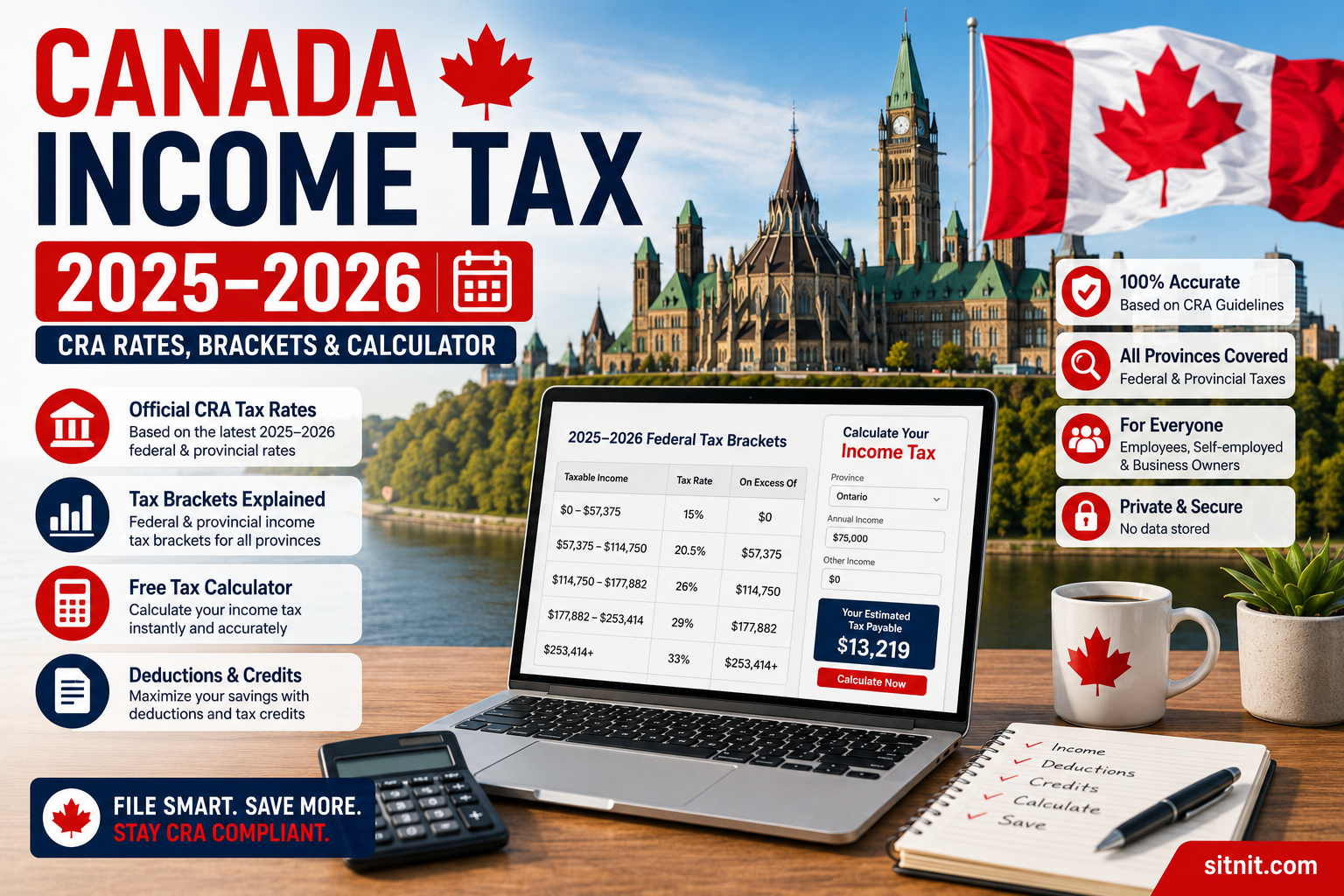
Five federal brackets apply in 2026: 14% up to $58,523, 20.5% up to $117,045, 26% up to $181,440, 29% up to $258,482, and 33% above that. The Basic Personal Amount ($16,452) is tax-free federally. Provincial tax, CPP, and EI come off on top. Your marginal rate (the bracket table) and your real take-home number can differ a lot once you account for where you live and any benefits that phase out with income — use a calculator for the exact figure rather than the table alone.
- What Changed Between 2025 and 2026
- Federal Tax Brackets 2026 — All 5 Bands
- 2025 Federal Brackets (For Your T1 Return)
- The Basic Personal Amount
- CPP and EI — What Comes Off Every Paycheque
- Provincial Tax and Province-Specific Calculators
- Real Take-Home Pay at Every Salary Level
- Worked Example: $80,000 in Ontario, 2026
- The Marginal Rate Trap — Hidden Benefit Clawback Zones
- Why Identical Salaries Pay Different Tax
- RRSP and TFSA — Two Legal Ways to Cut Your Tax Bill
- When NOT to Contribute to Your RRSP
- Capital Gains Tax in Canada
- Salary vs Dividends for Incorporated Owners
- Myth vs Reality
- 5 Tax Mistakes Canadians Make
- Pro Tips to Reduce Your Tax Bill
- FAQ
- Final Notes
What Changed Between 2025 and 2026
The headline change: the lowest federal tax rate dropped from 15% to 14% on July 1, 2025. Because the cut landed mid-year, the CRA couldn’t apply two rates to one filing year, so 2025 uses a blended 14.5% rate — 2026 is the first full calendar year at the true 14% rate.
| 2025 Tax Year (T1 filed 2026) | 2026 Tax Year (current) | |
|---|---|---|
| Lowest federal rate | 14.5% (blended) | 14% ↓ |
| First bracket ceiling | $57,375 | $58,523 ↑ |
| Second bracket ceiling | $114,750 | $117,045 ↑ |
| Third bracket ceiling | $177,882 | $181,440 ↑ |
| Fourth bracket ceiling | $253,414 | $258,482 ↑ |
| Basic Personal Amount | $16,129 | $16,452 ↑ |
| CPP ceiling (YMPE) | $71,300 | $74,600 ↑ |
| EI rate (employee) | 1.66% | 1.63% ↓ |
| RRSP limit | $32,490 | $33,810 ↑ |
Brackets are indexed 2% for 2026, so inflation alone doesn’t push you into a higher bracket without a real income gain (“bracket creep”). For a typical $70,000 earner, the lower rate plus higher thresholds save roughly $350–$450 in federal tax versus 2025.
Federal Tax Brackets 2026 — All 5 Bands Explained
These are marginal rates, confirmed against the CRA’s T4032 payroll deduction tables. Each rate applies only to the income within that band — never your entire income. Misunderstanding this is what makes people turn down raises they shouldn’t (see the Myth vs Reality table below).
At $80,000 of income (Band 2), only $21,477 is taxed at 20.5%. Your effective federal rate across the whole $80,000 sits around 16%, because the earlier dollars are still taxed at 14% first.
Enter your income and pick your province — including Ontario, BC, Alberta, and Manitoba — for federal tax, provincial tax, CPP, EI, and take-home pay for both 2025 and 2026.
Use the Free Canada Income Tax Calculator → Covers all 13 provinces and territories, plus a reverse tax calculator mode if you want to work backward from take-home pay.
2025 Federal Brackets — For Your T1 Return Filed in 2026
| Taxable Income | Federal Rate | Max Federal Tax (This Band) | Note |
|---|---|---|---|
| Up to $57,375 | 14.5% | $8,319 | Blended: 15% Jan–Jun, 14% Jul–Dec 2025 |
| $57,375–$114,750 | 20.5% | $11,762 | Unchanged from 2024 |
| $114,750–$177,882 | 26% | $16,414 | Unchanged from 2024 |
| $177,882–$253,414 | 29% | $21,904 | BPA taper applies |
| Above $253,414 | 33% | No cap | Top federal rate |
The Basic Personal Amount — Your Tax-Free Threshold
The BPA is the most important non-refundable credit in the system. For 2026, the federal BPA is $16,452 — worth a $2,303 credit ($16,452 × 14%), effectively making your first $16,452 tax-free federally. You don’t claim it separately; it’s applied automatically.
The taper for high earners: above $181,440 in net income, the BPA phases down until it reaches $14,829 at $258,482. That’s what pushes the effective marginal rate in Band 4 to roughly 29.3% instead of a clean 29%.
Provincial BPAs are separate and vary widely — Ontario’s is $11,865, Alberta’s is $21,003 (the highest in the country), which is part of why Alberta has the lowest combined tax burden of any province at most income levels.
CPP and EI — What Comes Off Every Paycheque
| CPP — Canada Pension Plan 2026 | EI — Employment Insurance 2026 | ||
|---|---|---|---|
| CPP1 rate (employee) | 5.95% | EI rate (employee) | 1.63% |
| CPP1 earnings range | $3,500–$74,600 | Max insurable earnings | $68,900 |
| CPP1 max (employee) | $4,230.45/yr | Max employee premium | $1,123.07/yr |
| CPP2 rate (employee) | 4% | EI rate (employer) | 2.28% |
| CPP2 earnings range | $74,600–$85,000 | Max employer premium | $1,572.30/yr |
| CPP2 max (employee) | $416/yr | Self-employed EI | Optional opt-in |
| Basic exemption | $3,500 | Quebec EI rate | 1.32% (different) |
| Self-employed rate | 11.9% (both parts) |
Provincial Tax — How It Stacks on Top, and Province-Specific Numbers
Every Canadian pays federal and provincial tax together (Quebec residents file a separate provincial return with Revenu Québec, but the logic is the same). Your total marginal rate is federal + provincial marginal rate combined.
| Province | Lowest Rate | Top Rate | Top Combined Rate | Burden |
|---|---|---|---|---|
| Alberta | 10% | 15% | 48% | Lowest |
| Saskatchewan | 10.5% | 14.5% | 47.5% | Low |
| British Columbia | 5.06% | 20.5% | 53.5% | Mid–High |
| Ontario | 5.05% | 20.53% | 53.53% | High |
| Quebec | 14% | 25.75% | 53.31% | High |
| Manitoba | 10.8% | 17.4% | 50.4% | Mid |
| Nova Scotia | 8.79% | 21% | 54% | Highest |
| New Brunswick | 9.4% | 19.5% | 52.5% | Mid-High |
A $100,000 earner in Alberta pays roughly $4,500 less combined tax than the same earner in Ontario — Alberta’s flat 10% rate and no provincial sales tax make it the clear low-tax outlier. If you’re comparing your own province, the Canada Income Tax Calculator runs the same math for BC, Manitoba, and every other province — no separate province tool needed.
Real Take-Home Pay at Every Salary Level — Ontario, 2026
| Gross Salary | Federal Tax | Ontario Tax | CPP + EI | Total Deducted | Take-Home/Yr | Take-Home/Mo | Eff. Rate |
|---|---|---|---|---|---|---|---|
| $40,000 | $3,291 | $1,562 | $3,428 | $8,281 | $31,719 | $2,643 | 20.7% |
| $60,000 | $7,199 | $3,302 | $4,453 | $14,954 | $45,046 | $3,754 | 24.9% |
| $80,000 | $11,730 | $5,418 | $5,095 | $22,243 | $57,757 | $4,813 | 27.8% |
| $100,000 | $16,830 | $8,286 | $5,769 | $30,885 | $69,115 | $5,760 | 30.9% |
| $120,000 | $21,945 | $12,050 | $5,769 | $39,764 | $80,236 | $6,686 | 33.1% |
| $150,000 | $29,945 | $17,450 | $5,769 | $53,164 | $96,836 | $8,070 | 35.4% |
| $200,000 | $44,945 | $29,300 | $5,769 | $80,014 | $119,986 | $9,999 | 40.0% |
Figures are estimates — Ontario’s surtax adds complexity at higher incomes. Use the free calculator for exact numbers by province.
Worked Example: $80,000 Salary in Ontario, 2026
| Step | Amount |
|---|---|
| Gross annual salary | $80,000 |
| Federal: 14% on $58,523 (BPA applied) | −$5,890 |
| Federal: 20.5% on $21,477 | −$4,403 |
| Total federal income tax | −$10,293 |
| Ontario provincial tax (approx.) | −$5,418 |
| CPP1 (5.95% × $71,100) | −$4,230 |
| CPP2 (not applicable — below $74,600) | $0 |
| EI (1.63% × $68,900, maxed) | −$1,123 |
| Total deductions | −$21,064 |
| Annual take-home pay | $58,936 ($4,911/month) |
The Marginal Rate Trap — Hidden Benefit Clawback Zones
This is the part almost every tax guide skips, and it’s often the most expensive gap in someone’s tax planning.
Your marginal tax rate is only part of the story. Several federal benefits reduce as income rises, and stacking that reduction on top of your marginal rate can push your true effective rate on the next dollar earned into the 40–60%+ range — even for middle-income families.
Where this happens:
- Canada Child Benefit (CCB): starts reducing once family net income crosses roughly $36,502, with a steeper reduction rate above roughly $79,087. A family in this zone can lose 13–23 cents of CCB per extra dollar earned, on top of regular tax.
- GST/HST Credit: phases out gradually with income — a smaller effect individually, but it stacks with everything else.
- OAS Recovery Tax (the “OAS clawback”): for retirees, once net income exceeds roughly $93,000+ (indexed annually), OAS is clawed back at 15 cents per dollar above the threshold — this only affects seniors receiving OAS.
- Provincial income-tested benefits: many provinces layer their own phase-out programs (childcare subsidies, drug plans, rent assistance) on top of federal ones.
| Family Net Income | Stated Marginal Tax Rate | + CCB Reduction | True Effective Rate on Next $1,000 |
|---|---|---|---|
| $35,000 | ~20% | 0% (below threshold) | ~20% |
| $50,000 | ~29.6% | ~13% | ~40%+ |
| $85,000 | ~29.6% | ~23% | ~50%+ |
| $130,000 | ~35% | 0% (CCB exhausted) | ~35% |
Illustrative example, family with 2 kids under 6.
The takeaway: if you’re deciding whether extra income is “worth it,” don’t stop at the bracket table. Run the actual after-clawback number — especially in the $50,000–$90,000 family income zone, or near the OAS clawback threshold in retirement.
Why Identical Salaries Pay Different Tax — The Credit-Stacking Problem
Two Canadians earning exactly $55,000 can end up with meaningfully different tax bills, and it has nothing to do with deductions — it’s about which non-refundable credits each person can actually use.
Non-refundable credits reduce your tax owing, but only down to zero — they can’t create a refund, and unused amounts usually just disappear rather than carrying forward. That’s different from a deduction (reduces taxable income before tax) and different from a refundable credit (pays out even if you owe nothing).
| Credit Type | How It Works | Carries Forward? | Example |
|---|---|---|---|
| Refundable credit | Paid out even with zero tax owing | N/A | GST/HST credit |
| Non-refundable credit | Reduces tax owing to zero, no further benefit | Usually no | Basic Personal Amount, CPP/EI credits |
| Non-refundable, transferable | Can move to a spouse or parent if unused | Sometimes | Tuition (up to $5,000/yr to a parent) |
| Deduction | Reduces taxable income directly | Often yes | RRSP contribution room |
Where this creates real differences between identical salaries:
- Medical expense credit: only the amount above the lesser of 3% of net income or a fixed CRA threshold counts — a lower-income earner effectively gets a bigger credit on the same spending.
- Tuition credits: a student with no tax owing can transfer up to $5,000 of unused tuition credit to a parent, but only in that same year; otherwise it carries forward with the student, not the parent.
- Donation credit tiering: 15% federal credit on the first $200, jumping to 29–33% above that — timing and bundling donations across years changes their real value.
- Disability Tax Credit (DTC): often unused by lower-income individuals with little tax owing — it can be transferred to a supporting family member instead.
The practical insight: if your household has two earners, running credits through the lower earner sometimes wastes value because they don’t owe enough tax to use them. Coordinating who claims medical, donation, and tuition-transfer credits across a household is a free optimization most people never do.
RRSP and TFSA — Two Legal Ways to Cut Your Tax Bill
RRSP — Registered Retirement Savings Plan
2026 limit: $33,810 (or 18% of 2025 earned income, whichever is lower). Contributions reduce taxable income dollar-for-dollar; tax is deferred until withdrawal, ideally in a lower-income year. The 2025 deadline is March 1, 2026. Unused room carries forward indefinitely — the CRA explains exactly how your RRSP deduction limit is calculated. The Home Buyers’ Plan allows first-time buyers to withdraw up to $60,000 tax-free for a qualifying purchase.
TFSA — Tax-Free Savings Account
2026 annual limit: $7,000 (cumulative room from 2009). Contributions come from after-tax income, but all growth and withdrawals are completely tax-free. No deadline, no income requirement, and withdrawals restore room the following year — see the CRA’s guidance on how TFSA contribution room accumulates. Total cumulative room since 2009 is $102,000 for anyone who has never contributed.
The practical choice: if your current marginal rate is meaningfully higher than your expected retirement marginal rate, RRSP wins. If they’re similar — or your retirement income might be higher — TFSA usually wins. Many people benefit from using both.
When NOT to Contribute to Your RRSP
Standard advice says “always contribute to your RRSP to reduce taxable income.” That’s true often enough to become conventional wisdom — and wrong often enough to cost real money for a meaningful share of Canadians.
Cases where RRSP contributions backfire:
- You’re in the lowest tax bracket now. A 14% deduction today isn’t worth much if you’ll be withdrawing at a similar or higher rate later.
- You may qualify for GIS in retirement. The Guaranteed Income Supplement is clawed back at 50–75 cents per dollar of other retirement income, including RRSP/RRIF withdrawals — a combined effective rate on withdrawal that can exceed 60–70%.
- You have high-interest debt. Credit card or unsecured debt at 20%+ interest almost always beats the tax-deferral benefit of an RRSP contribution.
- You’re early in your career with rising income ahead. RRSP room carries forward indefinitely — deferring the contribution to a higher-income year captures a bigger deduction later.
- You’re saving for a first home and haven’t opened an FHSA yet. The FHSA gives you the RRSP-style deduction and tax-free withdrawal for a home purchase — strictly better for that specific goal.
✅ Contribute to RRSP if: your marginal rate now is clearly higher than your expected retirement rate, you’re not relying on GIS later, and you have no high-interest debt.
🚫 Hold off if: you’re in the lowest bracket, GIS may apply to you later, you’re carrying high-interest debt, or an FHSA/TFSA better fits your current goal.
Capital Gains Tax in Canada
Canada has no separate capital gains tax rate — a portion of the gain is added to regular taxable income and taxed at your marginal rate. That portion is the inclusion rate: 50% on the first $250,000 of annual capital gains, and 66.67% above $250,000, for individuals in 2025–2026.
Sell an investment with a $20,000 gain, and $10,000 (50%) is added to taxable income. On a $500,000 gain, the first $250,000 has 50% included and the excess has 66.67% included. Our calculator’s capital gains mode runs this exact math against your province and marginal rate.
Gains inside a TFSA: never taxed. Inside an RRSP: deferred until withdrawal, then taxed as regular income. Principal residence gains: fully exempt, regardless of amount. The Lifetime Capital Gains Exemption shelters up to $1.25 million of qualifying small business shares or farm/fishing property in 2026.
Salary vs Dividends for Incorporated Business Owners (TOSI-Aware)
This section assumes you already understand personal marginal tax. It’s written for incorporated freelancers, contractors, and small business owners deciding how to pay themselves — not for employees.
If you run your business through a corporation, “how much tax do I pay” becomes a structuring decision, not just a bracket lookup. The two levers are salary and dividends, and the old blanket advice (“just take dividends, it’s more tax-efficient”) is outdated, and in some cases actively wrong, since the 2018 Tax on Split Income (TOSI) rules.
Salary: deductible corporate expense; creates RRSP room and CPP pensionable earnings (you pay both employee and employer CPP as the owner — 11.9% combined in 2026); taxed personally at standard marginal rates.
Dividends: paid from after-corporate-tax profit; no CPP contributions, no RRSP room created; taxed personally via the dividend gross-up and tax credit mechanism, designed to roughly “integrate” with corporate tax already paid — though timing and provincial mix shift this in practice.
Decision-tree logic:
- Do you need RRSP room or CPP-insured income? Salary contributes to both; pure dividends contribute to neither.
- Is your spouse or adult child a shareholder receiving dividends? Check TOSI. Since 2018, dividends to family members who don’t work meaningfully in the business, aren’t over 65, and don’t hold “excluded shares” are typically taxed at the top marginal rate regardless of the recipient’s actual income — killing the old income-splitting strategy in most cases.
- Is your business income above the small business deduction threshold (~$500,000 active business income)? Income above that faces the higher general corporate rate, changing the math.
- Do you need to show income for a mortgage application? Lenders often weight salary more predictably than fluctuating dividend income.
- Are you close to retirement and want CPP benefits? Dividend-only owners often have minimal CPP entitlement since dividends aren’t pensionable earnings.
“Pay yourself in dividends to save tax” is 2015-era advice. Post-TOSI, the right mix depends on your family’s shareholding structure, your RRSP/CPP goals, and whether family members are “excluded shareholders.”
Myth vs Reality — 7 Canadian Tax Myths That Cost People Money
| Myth | Reality |
|---|---|
| “A raise into a higher bracket means I take home less overall” | Only income above the new threshold is taxed higher — clawback zones can still shrink the net benefit, but you never lose money by earning more. |
| “RRSP is always better than TFSA” | Reverses for low-income earners and anyone who may rely on GIS in retirement. |
| “Moving provinces any time in the year saves tax immediately” | Only residency on December 31 determines your provincial tax for the entire year. |
| “Self-employed people can deduct almost anything” | CRA applies a reasonableness test on the T2125 form — personal-use portions must be excluded. |
| “Filing late is harmless if I don’t owe anything” | Late filing can suspend CCB, GST credit, and other benefit payments regardless of tax owed. |
| “CPP2 works the same as CPP1” | CPP1 generates a tax credit; CPP2 generates a tax deduction — different mechanics. |
| “Capital losses are wasted if I have no gains this year” | Losses can be carried back 3 years or forward indefinitely. |
5 Tax Mistakes Canadians Make
Missing the RRSP deadline
The 2025 RRSP deadline is March 1, 2026 — two months before the April 30 filing deadline, and many people conflate the two.
Not claiming CPP and EI credits
Both generate non-refundable credits at 14% federally, worth roughly $592 (CPP) plus $157 (EI) at maximum contributions in 2026.
Confusing marginal rate with effective rate
A $100,000 Ontario earner has a marginal rate around 43.4% but an effective rate closer to 31%. Using marginal rate to estimate take-home always overstates the burden.
Ignoring carry-forward room
RRSP and TFSA room carry forward indefinitely. Someone who’s never contributed to a TFSA since 2009 has $102,000 in room available in 2026.
Not paying required instalments
Owing more than $3,000 in net tax for 2025 triggers mandatory quarterly instalments for 2026, with interest at the prescribed rate plus 4% if missed.
Pro Tips to Reduce Your Canadian Tax Bill
Frequently Asked Questions — Canada Income Tax 2025–2026
What are the Canadian federal income tax brackets for 2026?
14% up to $58,523; 20.5% on $58,523–$117,045; 26% on $117,045–$181,440; 29% on $181,440–$258,482; 33% above $258,482. The federal BPA is $16,452, worth a $2,303 credit. Provincial tax adds on top.
Why was the lowest federal tax rate 14.5% in 2025?
Bill C-4 cut the rate from 15% to 14% effective July 1, 2025, mid-tax-year. The CRA blended the two rates for 2025 (14.5%); 2026 is the first full year at 14%.
What is a marginal tax rate, and how is it different from my “real” tax rate?
Your marginal rate is the rate charged on your next dollar of income — the highest bracket you touch. Your effective (average) rate is your total tax divided by total income, and it’s always lower, because earlier dollars were taxed at lower rates first. A $100,000 Ontario earner has a marginal rate around 43.4% but an effective rate closer to 31%.
What does the CRA consider “low income”?
The CRA doesn’t use one single “low income” cutoff for everything — different programs use different thresholds (GST/HST credit, CCB, provincial benefits). As a rough anchor, income below the Basic Personal Amount ($16,452 federally in 2026) pays no federal tax, and several income-tested credits phase in fully below roughly $36,000–$40,000 of net income depending on the benefit and household size.
Are tips taxable in Canada?
Yes. Tips and gratuities — whether paid in cash, added to a bill, or pooled — are taxable income in Canada and should be reported, regardless of whether your employer includes them on your T4. Under-reporting tips is one of the more common CRA audit triggers in the service industry.
How much foreign or dividend income is tax-free in Canada?
Neither is automatically tax-free. Foreign income is generally taxable in Canada for residents (foreign tax credits can offset double taxation). Canadian eligible dividends get preferential treatment through the dividend gross-up and tax credit, which can make a meaningful amount effectively tax-free at lower incomes — but the exact tax-free threshold depends on your province and other income, which is why it’s worth running through a calculator rather than relying on a flat number.
What is Line 15000 on my tax return, and how do I find it?
Line 15000 is your total income before deductions — the sum of employment income, self-employment income, investment income, and other sources reported on your T1. You’ll find it on your Notice of Assessment or in your CRA My Account under “Tax Returns.” It’s the figure most lenders and government programs ask for when they want your gross income.
What is a CRA Notice of Assessment?
It’s the CRA’s official summary of your tax return after processing — confirming what you owe or your refund, your RRSP deduction limit for next year, and your TFSA contribution room. Keep it; you’ll need the numbers on it (like Line 15000) for mortgage applications, student loans, and next year’s RRSP calculations.
When do I get my tax refund?
The CRA typically issues refunds within about 2 weeks for returns filed online with direct deposit, and up to 8 weeks for paper returns. Filing earlier in the season (rather than close to April 30) generally means a faster refund.
How much is CPP and EI in Canada for 2026?
CPP1: 5.95% on $3,500–$74,600 (max $4,230.45/yr). CPP2: 4% on $74,600–$85,000 (max $416/yr). EI: 1.63% up to $68,900 insurable earnings (max $1,123.07/yr). Self-employed pay both CPP shares (11.9%) but can opt into EI voluntarily.
Does Canada have a capital gains tax?
No separate rate — 50% of gains up to $250,000/year is included in taxable income, 66.67% above that. TFSA gains are tax-free; RRSP gains are tax-deferred; principal residence gains are exempt.
Is it always better to take dividends instead of salary if I’m incorporated?
No — this outdated advice ignores TOSI rules (2018+), RRSP/CPP room, and mortgage-qualification factors. See the “Salary vs Dividends” section above for the actual decision framework.
Final Notes
Canada’s income tax system for 2026 is more predictable than it looks at first glance — five federal brackets, a BPA that shields the first $16,452, and CPP/EI that follow a straightforward formula. The real complexity sits at the margins most guides skip: benefit clawback zones, credit-stacking across a household, when RRSP contributions actually backfire, and the salary-vs-dividend decision for incorporated owners.
Two actions that help almost everyone: file your 2025 T1 before April 30, 2026, and check your unused RRSP and TFSA room in CRA My Account.
Federal + provincial tax, CPP, EI, and take-home pay for 2025 and 2026, across all 13 provinces and territories.
Open the Free Canada Income Tax Calculator →
Sources: Canada Revenue Agency — current-year federal tax rates and brackets, T4032 Payroll Deductions Tables 2026, CPP contribution rates, TFSA contribution room rules, and RRSP deduction limit rules. All figures are for planning purposes only; individual situations vary. Consult a CPA or registered tax professional for advice specific to your situation.
Article last updated: September 24, 2026.