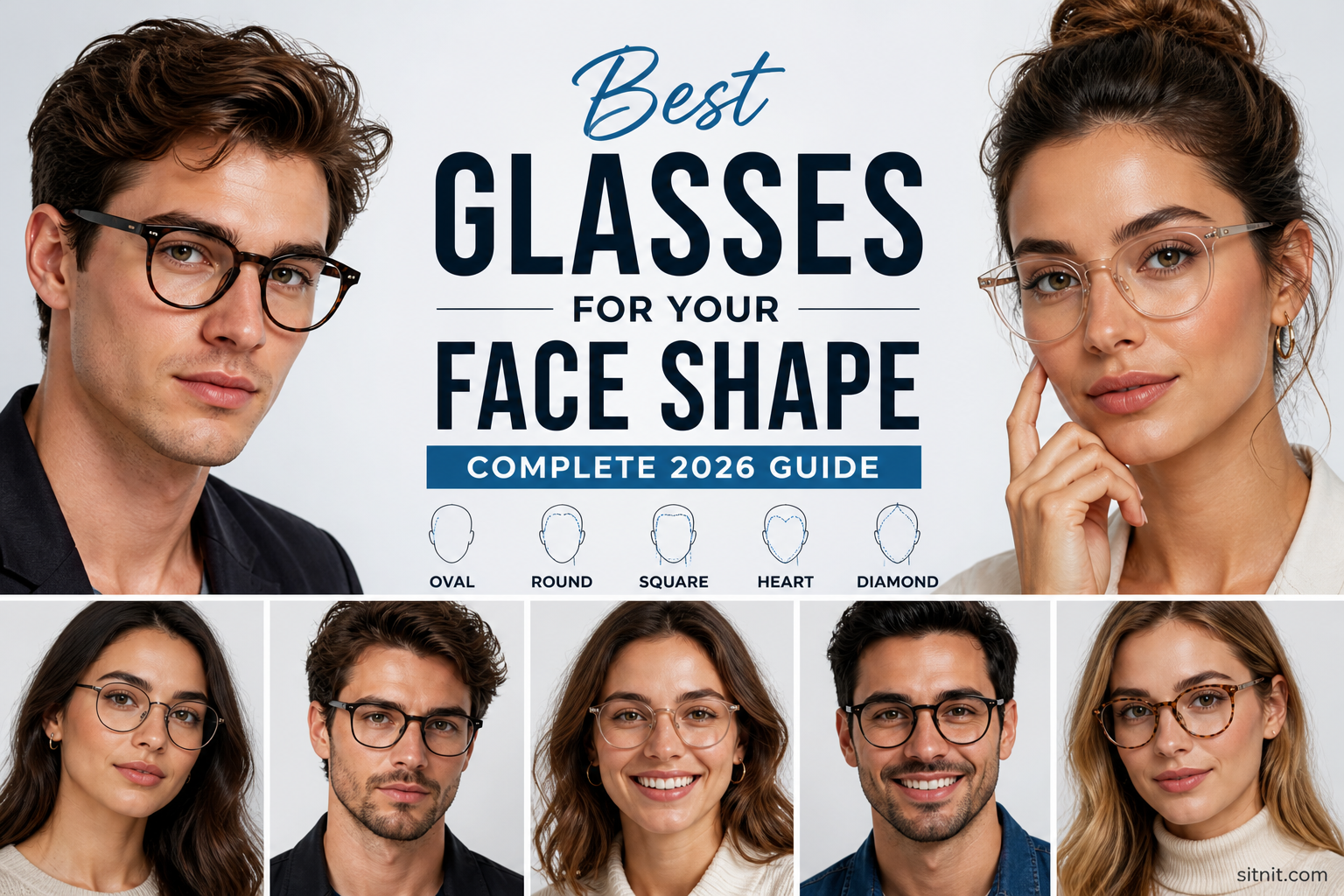
Best Glasses for Your Face Shape: Complete 2026 Guide
Style · Eyewear · AI Personal Care
Best Glasses for Your Face Shape: Complete 2026 Guide
Last Updated: May 2026|12 min read|Sitnit Editorial Team
You tried on thirty pairs and walked out with nothing. Or worse — you bought a pair online that looked perfect on the model and completely wrong on your face. You are not bad at choosing glasses. You are choosing without knowing the one variable that changes everything: your face shape.
The right glasses frame is not about what is fashionable right now. It is about geometry. The frame shape that works for you is determined by the shape of your face — and once you know that, the decision becomes dramatically simpler.
✦ Quick Answer — Best Glasses for Your Face Shape
The best glasses for your face shape work by contrast — choosing frame shapes that balance your natural features. Round faces suit angular frames. Square faces suit round or oval frames. Oval faces suit almost anything. Heart-shaped faces suit bottom-heavy frames. Use a free AI glasses finder to get a personalised recommendation for your exact face shape in under 60 seconds.
This guide covers all six face shapes in depth — what works, what to avoid, why the geometry matters, and how to apply it when you are actually standing in front of a mirror or shopping online. Every shape has a specific frame strategy, not a vague list of suggestions.
The One Rule That Governs Every Frame Choice
Every piece of glasses advice you will read — including everything in this guide — flows from a single principle. Understanding it means you never have to memorise rules by face shape again.
The Contrast Principle
Choose frames that are opposite to your face shape. Angular face → curved frames. Round face → angular frames. The frame balances what your face already has rather than repeating it. The more contrast, the more the frame flatters.
This is why round glasses on a round face tend to look unflattering — they echo the same shape. And why rectangular glasses on a square face can emphasise the jaw rather than balance it. The contrast principle is not a preference or a trend. It is geometry.
The second rule — which works alongside contrast — is proportion. Frame width should roughly match the widest point of your face. Too wide and the frames overwhelm. Too narrow and they make the face appear wider. Both the shape and the size matter.
→ Related
Glasses work with your full personal style picture. If you have not yet identified your face shape, eye shape, or skin tone, our complete AI personal care tools give you all three instantly — free, no login required.
Best Glasses for All 6 Face Shapes — In Full Detail
Here is every face shape with its specific frame strategy — what works, what to avoid, and exactly why.
Face Shape 01
Round Face
Similar width and height · Soft curved jaw · Full cheeks
Round faces benefit most from angular frames that add structure and make the face appear longer and more defined. The contrast principle is strongest here — the more geometric the frame, the more it balances the circular face.
Best frames
RectangularSquareGeometricD-frame
Avoid
Round framesSmall oval
Key tipChoose frames wider than they are tall — landscape orientation adds horizontal structure without adding height.
Face Shape 02
Oval Face
Gently wider at cheekbones · Tapers at forehead and jaw
Oval is the most versatile face shape for glasses. Naturally balanced proportions mean almost any frame style works — the only real consideration is size. Do not let frames overwhelm your face or sit undersized.
Best frames
Almost anythingOversizedGeometricCat-eye
Avoid
Frames too wide for faceFrames too small
Key tipFrame width should match your cheekbone width — the widest point of an oval face. That is your sizing anchor.
Face Shape 03
Square Face
Strong angular jaw · Wide forehead · Similar width throughout
Square faces have strong angular features — a defined jaw and a broad forehead at similar widths. Curved frames soften these angles and create balance. Avoid angular frames that repeat the square structure.
Best frames
RoundOvalSoft geometricSemi-rimless
Avoid
Square framesVery rectangular
Key tipRimless or semi-rimless styles reduce visual weight on strong features — great for square faces who find full frames feel heavy.
Face Shape 04
Heart-Shaped
Wider forehead · Narrower jaw · Often a pointed chin
Heart-shaped faces are wider at the top and narrow toward the jaw. The goal is to balance the wider forehead by drawing visual attention downward with bottom-heavy or light-top frames.
Best frames
RoundOvalBottom-rimmedLight-top rimless
Avoid
Top-heavy framesExtreme cat-eyeVery wide frames
Key tipFrames with coloured or thick lower rims draw the eye downward — perfect for balancing a wider forehead.
Face Shape 05
Oblong Face
Longer than wide · Similar forehead and jaw · Long nose
Oblong faces are noticeably longer than they are wide. The goal is to add width and visual depth — making the face appear shorter and more balanced. Wide, deep frames achieve this naturally.
Key tipDecorative or bold temple arms add width at eye level — one of the most effective tricks for oblong faces that few articles mention.
Face Shape 06
Diamond Face
Widest at cheekbones · Narrow forehead and jaw
Diamond faces have prominent, wide cheekbones with a narrow forehead and jaw. The goal is to highlight the cheekbones while adding width to the narrower forehead and softening the overall structure.
Best frames
OvalCat-eyeRimlessSemi-rimless
Avoid
Narrow rectangularVery angular geometric
Key tipFrames with detailing or width at the brow line (like cat-eyes) add visual width to the narrower forehead — the defining challenge for diamond faces.
Not Sure Which Face Shape You Have?
Our free AI glasses finder detects your face shape and recommends the exact frame styles that suit you — in under 60 seconds. No guesswork. No login.
How to Find Your Face Shape for Glasses (Step by Step)
Knowing your face shape is the prerequisite for every frame decision. Here is how to identify it accurately in under two minutes.
Pull your hair completely back
Hair against your face disguises your face shape more than anything else. Use a headband, tie it back, or hold it off your face with both hands. Your forehead and hairline need to be fully visible for an accurate reading.
Look straight into a mirror
Face directly forward. Do not tilt your chin up or down. Tilting changes the apparent width of your jaw and forehead and throws the result off significantly.
Note the widest point of your face
Is it your forehead? Your cheekbones? Your jaw? Or is the width fairly consistent top to bottom? This single observation eliminates most face shape possibilities immediately. Cheekbones widest = diamond. Forehead widest = heart. Jaw widest = pear (uncommon). All similar width = square or oblong.
Check your jaw shape
Is your jaw rounded and soft? Angular and defined? Or does it taper to a point? Rounded jaw with similar face width = round. Angular jaw with similar face width = square. Tapered jaw that narrows to the chin = heart or oval.
Compare width to length
Is your face roughly as wide as it is long? Or noticeably longer than wide? Similar proportions = round or square. Longer than wide with soft features = oval. Longer than wide with angular features = oblong.
Confirm with the AI glasses finder
If you are uncertain — or two descriptions seem to fit — go to sitnit.com/ai-glasses-finder. It identifies your face shape from a photo in 60 seconds and immediately recommends the specific frame styles that work for your exact proportions.
💡 Pro Tip
Take a straight-on photo of your face with your hair back. Open it on your phone and trace your face outline with your finger. The shape you trace is far more accurate than what you see in a mirror — because a static image lets you examine the outline without your eyes constantly adjusting.
Complete Frame Style Reference — At a Glance
Use this as your quick reference when shopping — whether online or in store.
Face Shape
Best Frame Styles
Best Frame Size
Avoid
Why It Works
Round
Rectangular, square, angular geometric, D-frame
Wider than tall (landscape)
Round, small oval, circular
Angular edges add length and structure to a circular face
Oval
Almost any — oversized, cat-eye, geometric, aviator
Match widest face point
Oversized or undersized extremes
Natural balance means most frames complement the face
Oval and cat-eye add width at the brow to balance cheekbones
⚠️ The Sizing Rule Nobody Mentions Enough
Frame shape is only half the decision. Frame size is equally important — and frequently wrong. A round frame that is too small on a round face will look worse than a rectangular frame that fits correctly. Always check that the outer edge of the frame does not extend significantly beyond your temples, and that the frame does not sit so high on your face that it crowds your brow.
Who Needs This Guide Most?
Scenario 01
Getting a New Prescription
You have a new prescription and need frames that work both optically and aesthetically. Knowing your face shape before you walk into the optician means you arrive with a clear brief — which frame categories to try and which to skip. You spend less time in the chair and leave more confident.
Scenario 02
Shopping for Glasses Online
Online eyewear is significantly cheaper — Zenni, Clearly, Warby Parker all offer quality frames at a fraction of in-store prices. But without trying frames on, you are buying blind unless you know your face shape. Use the AI glasses finder first, then shop with confidence.
Scenario 03
Adding Sunglasses to Your Wardrobe
Sunglasses follow identical face shape rules to prescription glasses. If you have always bought sunglasses by trend rather than face shape, applying the contrast principle to your next purchase will be a noticeable difference — especially for round or square faces who rarely find the right sunglass style by accident.
Scenario 04
Updating After a Face Change
Weight changes, ageing, and health changes all alter face proportions. If your old frames looked great five years ago but feel off now, your face shape may have subtly shifted. Reidentifying your current face shape with the AI tool ensures your next frames match your actual face — not the face you had before.
→ Also Read
Your eye shape affects how frames sit on your face and which liner shapes work for the frame style you choose. See our guide: 6 eye shapes explained — because glasses interact with your eye shape as much as your face shape.
5 Common Glasses Mistakes for Every Face Shape
Mistake 1: Choosing by Trend Instead of Face Shape
Oversized rectangular frames are fashionable in 2026. They look extraordinary on oval faces. They emphasise a round face’s roundness and repeat a square face’s angularity. Trend is a starting point, not a rule. Use the trend as inspiration and then filter it through your face shape. If the trending frame style does not suit your shape, find a variant that does.
Mistake 2: Ignoring Frame Width
Shape gets all the attention. Width gets ignored. A perfectly shaped frame that is too wide makes your face appear narrower than it is. Too narrow and it makes the face appear wider. Always check that your frame width roughly matches your widest facial measurement — this is more correctable online than shape is.
Mistake 3: Choosing Frames That Match Your Face Shape
This is the most counterintuitive mistake — and the most common. Round glasses on a round face. Square glasses on a square face. It feels logical but looks wrong. The contrast principle exists for a reason. Choose frames that are different from your face shape, not the same.
Mistake 4: Not Considering Nose Bridge Height
A low nose bridge and a high-bridge frame will slip constantly and sit too high on your face. A high nose bridge in a low-bridge frame sits awkwardly. Bridge fit changes both comfort and how the frame geometry actually reads on your face. This is why the same frame can look different on two people with the same face shape.
Mistake 5: Buying Without Knowing Your Face Shape First
This sounds obvious only after you have experienced the frustration of returning glasses that looked wrong. Spend two minutes identifying your face shape before you look at a single frame. Use the mirror method above or the AI glasses finder. Every minute spent on this saves significant money and frustration later.
Expert Pro Tips for Every Face Shape
💡 Tip 1 — Use Colour to Enhance the Contrast Effect
Bold, dark frames on a round face increase the angular contrast effect. Lighter or transparent frames on a square face soften the strong features further. Colour amplifies what the shape does — or dilutes it. Use dark frames when you want maximum contrast and impact; lighter frames when you want softness.
💡 Tip 2 — Cat-Eyes Are Not Just for Oval Faces
Cat-eye frames with a subtle upswept outer edge work well for diamond and heart-shaped faces. Very dramatic cat-eyes do not flatter heart shapes — they reinforce the wide forehead. But moderate cat-eyes that lift gently at the outer corner are flattering across three face shapes, not just oval. The lift of the cat-eye is adjustable by degree.
💡 Tip 3 — Sunglasses Can Break the Rules More Than Prescription Glasses
With prescription glasses, fit and vision correctness are non-negotiable. With sunglasses, there is more room for expression. A round-faced person can wear round sunglasses for a specific aesthetic and make it work with intentional styling. The rules matter more for everyday frames you wear all day. Weekend or occasional sunglasses have more creative latitude.
💡 Tip 4 — Try Frames That Seem Wrong First
When you use the AI glasses finder or read the recommendations for your face shape, the suggested frames will sometimes feel counterintuitive — especially if you have always bought based on what looked good in pictures. Try those frames first before defaulting to your instinct. The contrast principle consistently surprises people.
💡 Tip 5 — Skin Tone Affects Which Frame Colour to Choose
Once you know your frame shape, use your skin undertone to choose the right frame colour. Warm undertones look best in tortoiseshell, gold, warm brown, and caramel frames. Cool undertones look best in black, silver, navy, dark grey, and cool rose frames. Neutral undertones suit both equally. If you have not identified your skin tone yet, our skin tone guide takes three minutes.
Frequently Asked Questions — Glasses for Face Shape
Apply the contrast principle: angular face shapes suit curved frames; curved or round face shapes suit angular frames. Specifically — Round: rectangular, square, or geometric frames. Square: round, oval, or soft geometric. Oval: almost any frame. Heart: round, oval, or bottom-heavy frames. Oblong: wide frames with deep lenses. Diamond: oval, cat-eye, or rimless. Use Sitnit’s free AI glasses finder for a personalised recommendation based on your exact proportions.
Pull your hair back and look directly into a mirror. Note the widest point of your face (forehead, cheekbones, or jaw) and your jaw shape (rounded, angular, or tapered). If your face is roughly as wide as it is long with a rounded jaw = round. Similar width throughout with angular jaw = square. Gently wider at the cheekbones tapering to forehead and jaw = oval. Wider forehead narrowing to jaw = heart. Longer than wide = oblong. Widest at cheekbones with narrow forehead and jaw = diamond. Or use the free AI glasses finder for instant detection.
Angular frames work best on round faces. Best options: rectangular frames (wider than tall), square frames, D-frame or flat-top styles, and angular geometric shapes. Why it works: the sharp corners and straight lines add structure and make the face appear longer and more defined. Avoid round or oval frames — they echo the circular face shape and emphasise roundness. Dark, bold frame colours increase the defining effect further.
Round and oval frames suit square faces best by softening the strong angular jaw and broad forehead. Also good: soft geometric frames with rounded corners, semi-rimless or rimless styles that reduce visual weight, and frames that are slightly wider than the jaw to balance proportions. Avoid: very square or rectangular frames that repeat the face’s angularity, and narrow frames that emphasise the jaw’s width by contrast.
Yes — oval is the most frame-versatile face shape. Because oval faces have naturally balanced proportions, most frame shapes complement rather than fight the face. The one consideration: frame width should roughly match the widest point of your face (your cheekbones). Frames significantly wider than the cheekbones look oversized; frames significantly narrower look proportionally small. Within that size guideline, shape choice is open.
Heart-shaped faces are wider at the forehead and narrower at the jaw. Best frames: round or oval glasses (curves balance the pointed chin), bottom-heavy or bottom-rimmed styles (draw attention downward), and rimless or light-top frames that reduce visual weight at the wider forehead. Avoid: cat-eyes with extreme upswept outer edges (emphasise wide forehead), very wide frames (add further width to the already-wide top), and top-heavy frame designs with thick upper rims.
Three Things to Take Away and Use Today
Finding the best glasses for your face shape is not complicated once you understand the geometry. And the geometry reduces to one rule applied across six face shapes.
First: The contrast principle is everything. Angular face → curved frames. Round face → angular frames. Oval face → almost anything. Apply this one rule and you eliminate the wrong category of frames before you try a single pair.
Second: Width matters as much as shape. A perfectly shaped frame in the wrong size will still look off. Match your frame width to the widest point of your face and you solve half the problem before you even consider shape.
Third: The best glasses for your face shape connect to your full personal style. Skin tone determines your best frame colour. Eye shape affects how liner works with the frame style. Hairstyle frames both your face and your glasses. Our complete AI personal care tools give you all of it in one place — face shape, eye shape, skin tone, and hairstyle — free, in under five minutes.
Find Your Perfect Frames Instantly — Free AI Glasses Finder
Upload a photo. Get your face shape detected and your exact frame recommendations in under 60 seconds. No login. No guesswork. No returns.
Glasses Face ShapeAI Glasses FinderRound Face GlassesSquare Face FramesHeart Face EyewearOval Face GlassesEyewear Guide 2026Frame SelectionPersonal Care AIStyle Tips 2026
Who is the Richest Person in the World 2025? | Top 10 Billionaires Who is the Richest Person in the World 2025? Richest Person in the World 2025 Discover the top 10 wealthiest individuals globally based on 2025 projections and net worth estimates $342B Richest Person $1.7T Top 10 Total 10 Billionaires World’s Richest Person…
How Much Tax Is Taken Out of a $50k, $75k, and $100k Salary in 2026? Understanding how much tax is taken out of a $50k salary in 2026, as well as $75k and $100k income levels, can help you plan your budget, savings, and financial goals more confidently. The IRS updates tax brackets every year based…
Finance · United States 🇺🇸 · Tax Year 2026 US Federal IncomeTax 2026: IRS Brackets,Rates & Calculator Last Updated: May 2026 | 13 min read | Sitnit Editorial Team | Verified: IRS Rev. Proc. 2025-32 & OBBBA 2025 Tax year 2026 covers income you earn from January 1 through December 31, 2026. What’s being withheld…
How to Start SIP in India (Beginner’s Guide 2025) If you’ve ever wondered how to start SIP and grow your money without stress, you are already one step ahead of most people who make the mistake of delaying investing and missing powerful opportunities. SIP, or Systematic Investment Plan, is one of the most proven, safe,…
2025 USA Mortgage Calculator | Accurate Payment Estimates sitnit.com USA Mortgage Calculator 2025 Calculate your monthly payment with the latest 2025 mortgage rules and guidelines Property Information Home Price ($) USD Down Payment 20% USD Loan Term 30 Years Fixed20 Years Fixed15 Years Fixed10 Years Fixed Loan Start Date Interest & Rates Interest Rate (%)…
Finance · Canada 🇨🇦 · Tax Guide 2025–2026 Published: May 2026 | Updated: September 24, 2026 | ~18 min read | Fact-checked against CRA T4032 Payroll Tables and the CRA’s current-year tax rates page Your salary and your take-home pay are two different numbers. Federal tax, provincial tax, CPP, and EI all come off before…
We use cookies
We use cookies to improve your experience and show relevant ads. You can accept all cookies, reject them, or manage your preferences below.
Functional
Always active
The technical storage or access is strictly necessary for the legitimate purpose of enabling the use of a specific service explicitly requested by the subscriber or user, or for the sole purpose of carrying out the transmission of a communication over an electronic communications network.
Preferences
The technical storage or access is necessary for the legitimate purpose of storing preferences that are not requested by the subscriber or user.
Statistics
The technical storage or access that is used exclusively for statistical purposes.The technical storage or access that is used exclusively for anonymous statistical purposes. Without a subpoena, voluntary compliance on the part of your Internet Service Provider, or additional records from a third party, information stored or retrieved for this purpose alone cannot usually be used to identify you.
Marketing
The technical storage or access is required to create user profiles to send advertising, or to track the user on a website or across several websites for similar marketing purposes.