Beauty · Style Guide
What Face Shape
Do I Have?
Complete Guide 2026
You have read that certain hairstyles flatter certain face shapes. That some glasses frames suit you and others do not. That beard styles, eyeshadow angles, and clothing proportions all change depending on this one variable. And yet — you might not actually know your own face shape.
Most people cannot answer “what face shape do I have?” with confidence. They guess, or they pick a description from an article that sounds vague enough to fit. Then they follow the wrong advice for the wrong face shape and wonder why it does not work. This guide fixes that — with a simple, repeatable method instead of guesswork.
Think of this guide as a manual face shape detector — no app required, no signup, and nothing to download. By the end, you will know what is my face shape with real confidence, and exactly what it means for every style decision you make: hairstyle, glasses, beard, and skin tone colour choices.
The 6 Face Shapes at a Glance
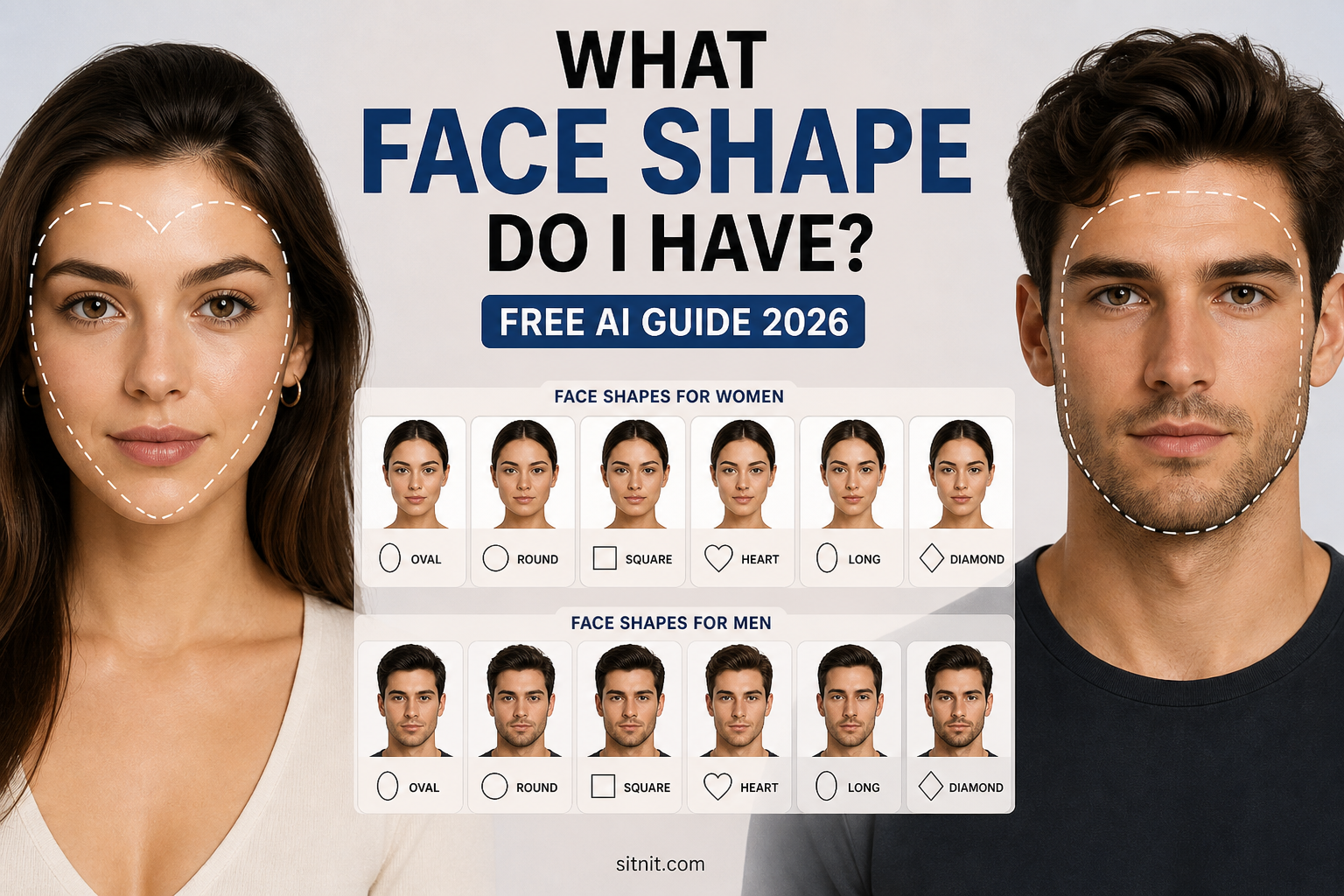
Every human face broadly falls into one of six shape categories used by stylists and opticians. Your face shape comes down to three measurements: the width of your forehead, the width of your cheekbones, and the width of your jaw — plus how your face length compares to all three. Here is the overview before we go deep on each one.
All 6 Face Shapes Fully Explained
Here is every face shape in detail — how to identify it precisely, what defines it structurally, and what it means for your style.
Oval Face Shape
Your face is noticeably longer than wide. The cheekbones are the widest point. The jaw tapers gently — rounded rather than angular. No single feature dominates. Mirror test: your face outline resembles a slightly elongated egg.
- Almost any hairstyle works — the most versatile shape
- Side parts, curtain bangs, waves all flatter
- Beards: most styles work — full beard adds distinction
- Avoid extremely voluminous styles that add too much width
- Glasses: any frame style — most versatile for eyewear
- Keep frame width matched to widest facial point
- Most clothing colours and necklines suit oval faces
- Try bold or statement frames with confidence
Round Face Shape
Your face is roughly as wide as it is long. The jaw is soft and rounded with no strong angles. Cheeks are full. The overall outline is circular. Mirror test: your face outline looks close to a circle.
- Add height at the crown — makes face appear longer
- Avoid blunt bobs at jaw level — widens the face
- Beards: a longer chin beard elongates the face
- Side-swept styles create a slimming effect
- Glasses: rectangular, square, or geometric frames
- Angular frames add definition and length
- Avoid round or oval frames — they echo the circular shape
- Vertical clothing stripes create a lengthening effect
Square Face Shape
Your jaw is angular and defined — roughly the same width as your forehead. The jawline corners are visible and structured. Mirror test: your face outline resembles a square or rectangle.
- Soft waves and layers soften the angular jaw
- Side parts add asymmetry that balances square structure
- Beards: round or oval beard shapes soften the jaw
- Avoid blunt-cut straight styles that emphasise angles
- Glasses: round, oval, and soft geometric frames
- Avoid square and rectangular frames — they repeat jaw shape
- Rimless styles reduce visual weight on strong features
- Soft rounded necklines balance the angular jaw
Heart Face Shape
Your forehead is clearly the widest point of your face. The face narrows progressively toward a jaw that is significantly narrower — often ending in a pointed or tapered chin. Mirror test: your face outline resembles an inverted triangle.
- Volume at jaw level balances a wide forehead
- Side-swept or curtain bangs minimise forehead width
- Beards: width at the jaw adds balance to a narrow chin
- Avoid extra volume at the crown — adds width to an already-wide top
- Glasses: round, oval, or bottom-heavy frames
- Avoid wide frames or extreme cat-eyes
- Light-top or rimless frames reduce forehead focus
- V-neck clothing draws the eye down, balancing a wide top half
Oblong Face Shape
Your face is noticeably longer than wide — more so than oval. The forehead and jaw are similar in width, and the sides of the face remain fairly parallel for much of the length. Mirror test: your face outline resembles a tall rectangle.
- Volume at the sides shortens the face visually
- Blunt fringes reduce face length perception
- Beards: width at the cheeks and a shorter chin length
- Avoid long straight styles that add further length
- Glasses: wide frames, deep lenses, decorative temples
- Avoid narrow or small frames — they emphasise length
- Horizontal clothing patterns reduce the length effect
- Bold earrings at cheek level add visual width
Diamond Face Shape
Your cheekbones are the widest point by a clear margin. Both your forehead and jaw are noticeably narrower. The face has a dramatic angular quality centred on the cheekbones. Mirror test: your face outline resembles a diamond.
- Volume at forehead and jaw adds width above and below the cheekbones
- Chin-length styles balance the narrow jaw
- Beards: fuller styles at the jawline balance a narrow chin
- Avoid extra volume at cheek level — already the widest point
- Glasses: oval, cat-eye, or browline frames
- Frames with width at the brow add to a narrow forehead
- Avoid narrow rectangular frames — they emphasise sharp cheekbones
- Boat-neck or wide-collar clothing balances a narrow jaw
How to Find Your Face Shape — Step by Step
The mirror method takes under two minutes. No measuring tape required — visual comparison is accurate enough for style purposes. For a definitive result, especially where two shapes seem similar, the photo method below resolves most borderline cases.
Complete Style Reference by Face Shape
Use this table as your permanent reference. Every style decision for your face shape in one place.
| Face Shape | Best Hairstyle | Best Beard | Best Glasses | Avoid |
|---|---|---|---|---|
| Oval | Almost anything — most versatile. Side parts, waves, curtain bangs all work. | Full beard, stubble, most styles | Any frame — try oversized or geometric | Very extreme volume that overwhelms proportions |
| Round | Height at crown, side-swept, layered. Avoid jaw-length blunt cuts. | Long chin beard to elongate face | Rectangular, square, angular geometric | Round frames, blunt bobs, very short styles |
| Square | Soft waves, layers, asymmetric side parts. Avoid blunt straight cuts. | Rounded oval beard, not square-shaped | Round, oval, semi-rimless | Square frames, heavy blunt fringes |
| Heart | Volume at jaw level, side-swept bangs. Avoid crown volume. | Wider styles at jaw to balance narrow chin | Round, oval, bottom-heavy | Wide frames, extreme cat-eye, heavy top-heavy styles |
| Oblong | Side volume, blunt fringes, horizontal layers. Avoid long straight styles. | Width at cheeks, short chin beard | Wide frames, deep lenses, decorative temples | Narrow frames, long styles with no volume |
| Diamond | Volume at forehead and jaw. Chin-length styles. Avoid cheekbone-level volume. | Fuller jaw beard to balance narrow chin | Oval, cat-eye, browline frames | Narrow rectangular frames, sharp angular styles |
Related Style Guides for Your Face Shape
Knowing your face shape is the starting point. Each guide below builds on it — giving you specific recommendations for hairstyle, beard, glasses, eye shape, and skin tone.
Who Needs to Know Their Face Shape?
Getting a New Haircut
You are due a haircut and want something different but do not know what to ask for. Knowing your face shape before you sit in the barber or stylist’s chair gives you a clear brief. See what hairstyle suits me for specific cuts to ask for.
Buying Glasses
You are shopping for frames — in store or online — and have no idea where to start. Face shape is the single filter that eliminates most frames before you try a single pair. Read glasses for face shape first, then shop with a specific frame category in mind.
Growing or Changing a Beard
You are considering growing a beard or changing your current style. The right beard shape adds balance to your face — the wrong one emphasises the features you want to soften. See beard styles for your face shape for specific grooming guidance.
Building a Complete Style Profile
You want to understand your personal style from the ground up — hairstyle, glasses, skin tone colours, eye makeup. Face shape is the foundation. Once you know it, every other recommendation becomes specific rather than generic. Work through the related guides above one by one.
5 Common Face Shape Mistakes
Mistake 1: Guessing Without Pulling Hair Back
Hair against your face changes its apparent shape more dramatically than almost anything else. Long hair narrows the face. Short hair widens it. Volume around the temples changes the widest point. Any assessment done without hair fully pulled back is unreliable. This is the most common reason people misidentify their face shape.
Mistake 2: Confusing Oval and Round
These two are the most commonly confused shapes. The difference is in the length-to-width ratio and the jawline. Oval faces are measurably longer than wide with a gentle, tapering jaw. Round faces are approximately equal in width and height with a fuller, more circular jaw. If it feels circular, it is round. If it feels elongated, it is oval.
Mistake 3: Thinking Face Shape Determines Attractiveness
No face shape is inherently more attractive than another. Oval gets described as “ideal” in many beauty articles — but this is because oval is the most versatile for style rules, not because it looks better. Every face shape has a style system that makes it look its best. The goal is not to change your shape. It is to work with it intelligently.
Mistake 4: Not Reassessing After Major Changes
Weight changes, ageing, and hormonal changes all alter facial proportions. A face that was square at 25 may be closer to oval at 45 as the jawline softens. Reassessing your face shape every five to ten years — or after significant weight change — ensures your hairstyle and style choices still serve your actual face rather than the face you had before.
Mistake 5: Using Face Shape Rules in Isolation
Face shape determines your style framework. But it works alongside your eye shape, skin tone, and facial features — not independently. A round face with deep-set eyes needs different glasses than a round face with protruding eyes. Your face shape is the starting point, not the complete answer.
Expert Pro Tips for Every Face Shape
Frequently Asked Questions — What Face Shape Do I Have?
Three Things to Take Away and Act On Today
Knowing what face shape you have changes every style decision you make — from the hairstyle you ask for at the salon, to the glasses frames you try first, to the beard shape that adds balance, to the colours that complement your features.
First: identify your face shape right now using the mirror or photo method above. Do this before you make your next style decision — every recommendation in every guide becomes specific once you know your shape.
Second: face shape is the starting point, not the complete picture. Your eye shape, skin tone, and hairstyle all work together. Use the related style guides above to build a complete picture.
Third: face shape is not about constraints — it is about working with your proportions rather than against them. Oval faces are called “versatile” because they suit many styles, but every shape has directions that work with its geometry. What face shape do I have is the first question; what to do with it is where the value lives.
Ready to Put Your Face Shape to Work?
Not 100% sure of your shape yet? Confirm it with our free face shape detector, then get a haircut brief built for your exact face shape.