Most cost-of-living guides give you a single average and move on. That average is usually wrong for your situation — because the difference between a PG in Whitefield and a 1BHK in Koramangala is larger than the difference between Bangalore and Hyderabad.
This guide does three things differently. It uses current 2026 rent and inflation data, not 2022 figures recycled into a new headline. It separates take-home pay from CTC, because that is where most relocation budgets quietly break. And it includes a working calculator on this page, so you can model your own numbers instead of applying a city average that may not fit your life.
Quick answer — India cost of living 2026
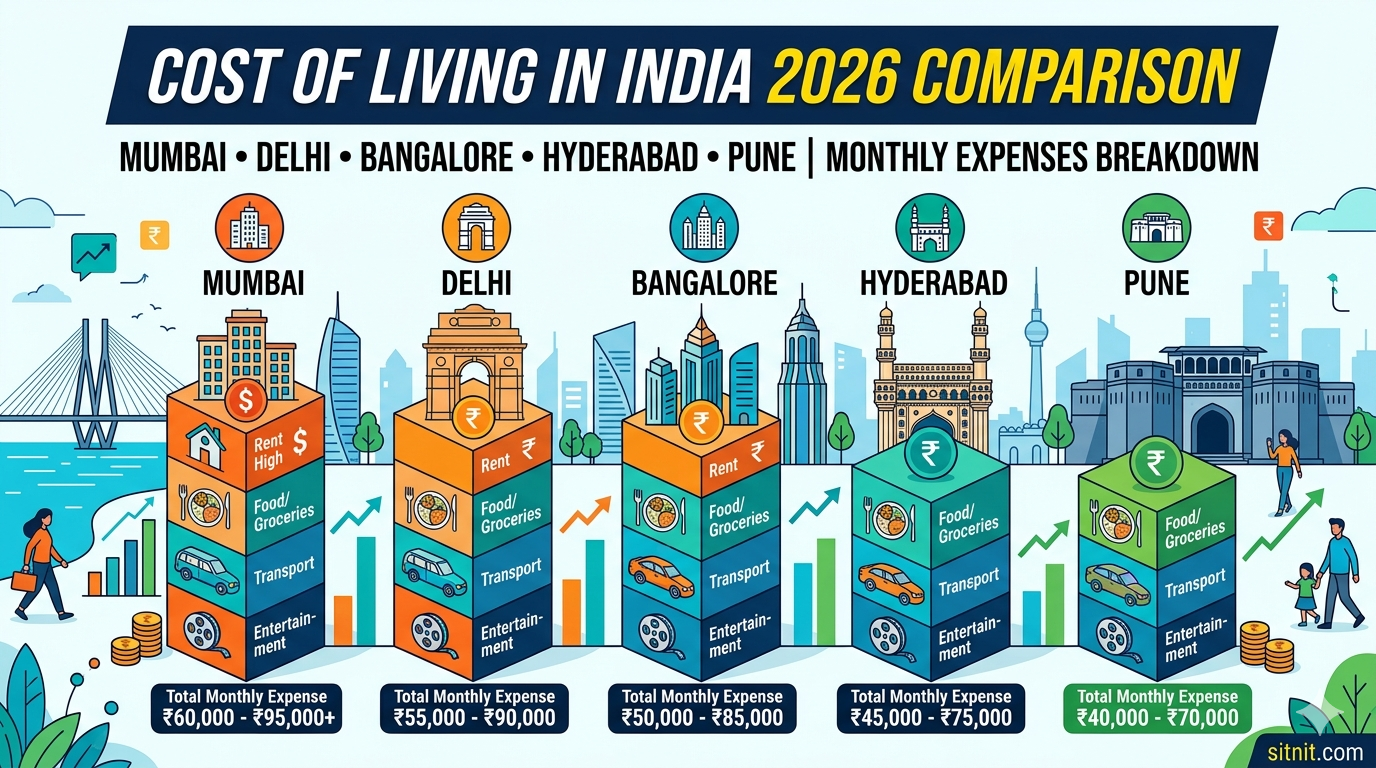
A single professional in a major Indian metro spends roughly ₹30,000–₹60,000 per month including rent for a moderate lifestyle. Hyderabad is the cheapest major metro (1BHK ₹10,000–₹18,000), Mumbai the most expensive (1BHK ₹20,000–₹35,000 in the suburbs). Numbeo’s March 2026 data puts average single-person spending excluding rent at about ₹27,300 nationally.
City overview and cost ranking
These figures assume a rented 1BHK, home-cooked meals most days, a mix of public transport and app cabs, and moderate discretionary spending. They are planning estimates, not quotes.
Mumbai₹42k–₹62k
Highest absolute cost. Rent is the whole story.
Delhi NCR₹33k–₹52k
Location within NCR changes the number by ₹10k+.
Bangalore₹32k–₹50k
High salaries, rising rents, expensive commutes.
Hyderabad₹26k–₹40k
Best rent-to-quality ratio among large metros.
Pune₹26k–₹40k
Mumbai-adjacent value; strong IT and manufacturing.
Chennai₹26k–₹42k
Affordable food and rent; underrated overall.
Estimated monthly cost — single professional (₹, moderate lifestyle)
Mumbai
₹52,000 avg
₹42k–₹62k
Delhi NCR
₹42,500 avg
₹33k–₹52k
Bangalore
₹41,000 avg
₹32k–₹50k
Chennai
₹34,000 avg
₹26k–₹42k
Pune
₹33,000 avg
₹26k–₹40k
Hyderabad
₹32,000 avg
₹26k–₹40k
Full monthly breakdown by city
01 · Maharashtra
Mumbai
Most expensive Indian city for a reason
₹42k–₹62k
per month
Monthly expenses (₹)
1BHK, Western Suburbs20,000–35,000
Food8,000–12,000
Transport2,500–5,000
Utilities + internet3,000–5,000
Discretionary5,000–8,000
Total₹42k–₹62k
What changes the number
South Mumbai 1BHK₹50k–₹90k
Navi Mumbai discount40–50% lower rent
Local train pass₹200–₹400/mo
Rent growth, 2025–26~8–12%
Brokerage (typical)1 month rent
Most expensiveTrain access changes the maths
02 · Delhi NCR
Delhi / NCR
The city average hides a ₹10k+ location gap
₹33k–₹52k
per month
Monthly expenses (₹)
1BHK, central Delhi15,000–28,000
1BHK, Noida/Gurgaon12,000–20,000
Food7,000–11,000
Metro + transport2,000–5,000
Utilities + internet2,500–4,500
Total₹33k–₹52k
What changes the number
Best value areasNoida, Dwarka
Delhi Metro coverageExcellent
Gurgaon premium15–30% vs Noida
Rent growth, 2025–26~7–10%
Moderate–highNCR suburbs are good value
03 · Karnataka
Bangalore
High pay, high rent, expensive commutes
₹32k–₹50k
per month
Monthly expenses (₹)
1BHK, prime areas15,000–25,000
1BHK, peripheral10,000–18,000
Food7,000–11,000
Transport (cab-heavy)3,000–6,000
Utilities + internet2,500–4,000
Total₹32k–₹50k
What changes the number
Rent growth, 2025–26~7–9% (cooling)
Traffic cost premium₹2k–₹4k/mo
Metro coverageExpanding but patchy
Security deposit5–10 months typical
Moderate–highHigh salaries offset costsCommute is a real line item
04 · Telangana
Hyderabad
Best rent-to-quality ratio in 2026
₹26k–₹40k
per month
Monthly expenses (₹)
1BHK, HITEC City15,000–25,000
1BHK, most localities10,000–18,000
Food6,000–9,000
Transport2,000–4,000
Utilities + internet2,000–3,500
Total₹26k–₹40k
What changes the number
vs Bangalore rent30–40% lower
Rent growth, 2025–26~10–15% in IT pockets
Salary gap vs Bangalore15–25% lower for equivalent roles
Best value metroLowest rent among large metros
Pune and Chennai: the quiet value options
Pune (₹26,000–₹40,000): A 1BHK in Baner, Wakad or Kharadi runs ₹10,000–₹18,000. You get metro-level salaries in IT and manufacturing with noticeably lower rent than Mumbai or Bangalore. The trade-off is smaller-scale nightlife and fewer high-end corporate roles.
Chennai (₹26,000–₹42,000): Food is the standout — ₹5,500–₹8,000/month is realistic. The IT corridor (Sholinganallur, Perungudi) has 1BHKs at ₹12,000–₹20,000. Chennai’s cost index is the lowest of the six at 20.0 (Numbeo, March 2026), though rent index is even lower at 4.4.
Side-by-side comparison table
Expense
Mumbai
Delhi NCR
Bangalore
Hyderabad
Pune
Chennai
1BHK rent
₹20k–₹35k
₹13k–₹28k
₹14k–₹28k
₹10k–₹20k
₹10k–₹18k
₹11k–₹20k
Food
₹8k–₹12k
₹7k–₹11k
₹7k–₹11k
₹6k–₹9k
₹6k–₹9k
₹5.5k–₹8k
Transport
₹2.5k–₹5k
₹2k–₹5k
₹3k–₹6k
₹2k–₹4k
₹2k–₹4k
₹2k–₹4k
Utilities + internet
₹3k–₹5k
₹2.5k–₹4.5k
₹2.5k–₹4k
₹2k–₹3.5k
₹2k–₹3.5k
₹2k–₹3.5k
Discretionary
₹5k–₹8k
₹4k–₹7k
₹4k–₹7k
₹3k–₹5k
₹3k–₹5k
₹3k–₹5k
Total
₹42k–₹62k
₹33k–₹52k
₹32k–₹50k
₹26k–₹40k
₹26k–₹40k
₹26k–₹42k
Approx. CTC for comfort
₹12–18 LPA
₹9–15 LPA
₹9–14 LPA
₹7–11 LPA
₹7–11 LPA
₹7–12 LPA
CTC estimates assume the new tax regime, ₹75,000 standard deduction, and no large EMIs. Use the income tax calculator for your exact take-home.
Working cost-of-living calculator
Adjust the inputs below to match your situation. The model uses city base costs for rent, food, transport, utilities and discretionary spending, then applies your housing, food and transport choices. It is deliberately transparent — you can see every assumption.
Estimate your monthly cost
All figures in ₹ per month. Take-home means salary after tax and PF.
Estimated monthly cost₹0
Estimate only. Actual costs vary by locality, lease terms, commuting distance and personal habits. Excludes EMIs, insurance premiums and one-time setup costs.
What city averages miss — and why it matters
City averages are useful for ranking, not for budgeting. Three variables move the number more than the city itself.
1. The CTC-to-take-home gap
A ₹12 LPA CTC in Bangalore and a ₹12 LPA CTC in Hyderabad do not produce the same monthly cash. Under the new tax regime for FY 2025–26, the slab structure is: nil up to ₹4 lakh, 5% from ₹4–8 lakh, 10% from ₹8–12 lakh, 15% from ₹12–16 lakh, 20% from ₹16–20 lakh, 25% from ₹20–24 lakh, and 30% above ₹24 lakh. The standard deduction is ₹75,000. PF contributions and professional tax further reduce take-home. Two offers with the same CTC can differ by ₹2,000–₹4,000 per month depending on structuring.
2. The rent escalation clause
Most Indian leases include a 7–10% annual increase. A ₹20,000 rent becomes ₹21,400–₹22,000 in year two. Over a three-year stay, that is ₹40,000–₹70,000 in additional rent — roughly one to two months of take-home pay that rarely appears in first-year budget comparisons.
3. The deposit and setup cost
Bangalore commonly asks for 5–10 months’ rent as a security deposit. Mumbai asks for 3–6 months. Delhi NCR is often 2–3 months. On a ₹20,000 rent, the upfront deposit alone ranges from ₹40,000 to ₹2,00,000 — before furniture, appliances, brokerage and utility connections. This is the single biggest reason new movers run out of cash in month one, and it does not show up in any monthly average.
Note on tax-saving claims
The old regime allows HRA exemption and an extra ₹50,000 NPS deduction under Section 80CCD(1B). The new regime — now the default for most salaried taxpayers — does not allow HRA or self-contributed NPS deductions. If a cost-of-living article tells you to “maximise HRA to cut tax” without checking your regime, it may be giving you advice that no longer applies to your salary structure.
Inflation and rent in 2026
Headline CPI inflation averaged about 2.1% in FY 2025–26, driven by food price deflation, and the RBI projects 4.6% for FY 2026–27. That is a very different picture from the 5–6% figures common in older guides.
Rent tells a different story. After 12–24% annual increases in 2021–24, metro rent growth cooled to roughly 7–9% in 2025 and is tracking 5–8% in 2026 in most cities. Bangalore’s average annual rent growth has moderated to about 7%, below the 10–13% seen in 2022–24. Mumbai and parts of Hyderabad still see sharper jumps in prime pockets, but the broad acceleration has eased.
Food inflation has also normalised. Vegetables and pulses, which spiked in 2024, have largely corrected. Restaurant prices, however, have not fallen — labour and ingredient costs rose and stayed elevated, so eating out remains 8–12% more expensive than in 2023.
Five budgeting mistakes when moving cities
Comparing CTC instead of take-homeUse the income tax calculator to convert each offer to monthly cash before comparing. A higher CTC with a different allowance structure can produce lower take-home.
Using rent data from 2022–23Bangalore and Hyderabad rents rose 30–50% between 2022 and 2025. Verify current listings on NoBroker, MagicBricks or 99acres for the specific locality, not a city-wide forum post.
Ignoring the commute as a cost lineA ₹5,000/month rent saving in a peripheral area can be erased by ₹4,000–₹6,000 in cabs and two extra hours of daily travel. Model commute cost and time together.
Forgetting the deposit and setup monthBudget separately for deposit, brokerage, furniture and utility connections. This is typically ₹80,000–₹2,50,000 depending on city and rent level.
Assuming rent stays flatAdd 7–10% to your rent for each renewal year. If you are using rent to assess loan eligibility or savings capacity, use the year-two number, not year one.
FAQ — Cost of living in India
For a single professional, a moderate lifestyle including rent ranges from roughly ₹30,000 in Hyderabad to ₹60,000 in Mumbai. Numbeo’s March 2026 data puts average single-person spending excluding rent at about ₹27,300 nationally. A frugal lifestyle in a smaller city can be ₹20,000 or less; a comfortable metro lifestyle with a 1BHK and regular cabs can exceed ₹65,000 in Mumbai.
Hyderabad. Its rent index (5.6 in March 2026) is the lowest among the six metros, and a 1BHK in most localities costs ₹10,000–₹18,000. Pune and Chennai follow closely on overall cost. Mumbai is the most expensive by a wide margin, driven almost entirely by rent.
Roughly ₹50,000–₹65,000 per month for a single person with a 1BHK in a prime area, balanced food, mixed transport and modest discretionary spending. On a gross CTC basis under the new regime, that is approximately ₹9–14 LPA, depending on PF and other deductions. Use the income tax calculator to convert your exact CTC.
Rent is 30–40% lower in Hyderabad for comparable 1BHKs. But Bangalore salaries for equivalent tech roles are often 15–25% higher. If your employer pays the same salary in both cities, Hyderabad leaves more disposable income. If the Bangalore offer is substantially higher, the gap narrows or reverses. Run both numbers through the calculator above using your actual offers.
Mumbai is roughly 25–35% more expensive overall. A 1BHK in Mumbai’s Western Suburbs costs ₹20,000–₹35,000; a comparable flat in Delhi NCR costs ₹13,000–₹22,000. Food and transport are closer in cost. Mumbai’s finance-sector salaries can be higher, which partly offsets the rent gap for some roles.
Headline CPI inflation was low — about 2.1% in FY 2025–26 — but rent is the cost that matters most to urban professionals. Rent growth has cooled from the 2021–24 spike to roughly 5–8% in 2026, though prime Mumbai and Hyderabad pockets still see larger increases. Overall, metro living costs are higher than in 2023, but the pace of increase has slowed compared with 2022–24.
Verdict: choose the city, then choose the locality
The city-level ranking is clear: Hyderabad offers the lowest cost for a comparable urban lifestyle, Mumbai the highest, and Bangalore sits in the middle with the widest gap between salary potential and living cost. But the city decision is only half the budget. The locality, the lease terms, the commute and the deposit matter just as much as the metro name on the offer letter.
If you are comparing offers, convert every number to monthly take-home minus year-two rent and realistic commute costs. That single calculation will tell you more than any city average. The calculator above is built to do exactly that.
Model your own numbers in under two minutes
Use the calculator on this page with your actual take-home and preferred locality. Then cross-check your tax with the free India income tax calculator.
Cost of Living India 2026Mumbai vs BangaloreHyderabad cost of livingDelhi NCR rentIndia take-home salaryRent inflation IndiaIndia new tax regimeMetro city comparison
Methodology and sources. Rent ranges are derived from current NoBroker, MagicBricks and 99acres listings (2026) and cross-checked against Numbeo India city data (March 2026) and Prorently’s 2026 rent guide. Inflation data from the RBI Annual Report 2025–26 and RBI monetary policy statements. Tax slabs from the FY 2025–26 new-regime schedule and Budget 2026 confirmations. Estimates are for planning only; actual costs vary by locality, lease terms and household. This page does not guarantee a specific budget outcome. Last updated: 21 November 2026. Author: Shivam.
Finance · United Kingdom 🇬🇧 · Tax Guide 2025-26 UK Income Tax 2025-26:Rates, Brackets &Your Real Take-Home Pay Last Updated: May 2026 | 13 min read | Sitnit Editorial Team | Verified: HMRC 2025-26 Rates You accepted a job at £55,000. Or received a pay rise to £102,000. Or you’re comparing a contractor rate to…
US Federal Income Tax Brackets 2025–2026 (Explained Simply) Federal income tax brackets decide how much tax you pay on your income in the United States. The U.S. follows a progressive tax system, which means different portions of your income are taxed at different rates — not your entire salary at one rate. Understanding this system…
Choosing the best credit cards in India in 2025 is not just about flashy designs or big promises — it’s about real value, real savings, and real benefits that match your lifestyle. Whether you are a student looking for easy cashback, a frequent traveler wanting airport lounge access, or a regular online shopper who loves…
Beauty · Style Guide What Face ShapeDo I Have?Complete Guide 2026 By Shivam | Updated: September 24, 2026 | 11 min read You have read that certain hairstyles flatter certain face shapes. That some glasses frames suit you and others do not. That beard styles, eyeshadow angles, and clothing proportions all change depending on this…
Finance · New Zealand 🇳🇿 · PAYE Guide 2026 NZ PAYE Calculator 2026:Complete Take-Home PayGuide for New Zealand Last Updated: May 2026 | 13 min read | By Shivam | Verified: IRD 2025–26 & 2026–27 Rates You accepted a job in New Zealand at $75,000. Or $100,000. Or $55,000. And now you want to know…
We use cookies
We use cookies to improve your experience and show relevant ads. You can accept all cookies, reject them, or manage your preferences below.
Functional
Always active
The technical storage or access is strictly necessary for the legitimate purpose of enabling the use of a specific service explicitly requested by the subscriber or user, or for the sole purpose of carrying out the transmission of a communication over an electronic communications network.
Preferences
The technical storage or access is necessary for the legitimate purpose of storing preferences that are not requested by the subscriber or user.
Statistics
The technical storage or access that is used exclusively for statistical purposes.The technical storage or access that is used exclusively for anonymous statistical purposes. Without a subpoena, voluntary compliance on the part of your Internet Service Provider, or additional records from a third party, information stored or retrieved for this purpose alone cannot usually be used to identify you.
Marketing
The technical storage or access is required to create user profiles to send advertising, or to track the user on a website or across several websites for similar marketing purposes.