Haircut for Men: Best Styles and How to Pick the Right One (2026)
Choosing a haircut for men is harder than it looks. Search results show hundreds of photos, but a cut that looks great on a model may not suit your face shape, hair texture or morning routine. This guide helps you narrow the choice: it explains the main styles, how to match them to your face and hair type, the barber terms you need, and how to ask for exactly what you want.
Short answer: start with your face shape, then your hair type (straight, wavy, curly, thinning), then how much time you will spend styling. Pick two or three styles that fit all three, bring reference photos, and ask your barber for a cut by guard number or length rather than by name alone. You can test options with our free hairstyle recommender before you sit in the chair.
How to choose a haircut for men: four factors
- Face shape. Cuts add or reduce height, width and sharpness around the face. This is the biggest visual factor.
- Hair type and density. Straight, wavy, curly and coily hair behave differently when cut. Fine or thinning hair needs a different approach from thick hair.
- Daily effort. A short crop takes almost no styling. A textured medium cut or long hair needs product and a routine.
- Maintenance schedule. Sharp fades look best when refreshed often. Longer styles forgive missed appointments.
Match your face shape to a haircut
These are common styling guidelines, not strict rules. Treat them as a starting point. Not sure of your shape? Use our face shape detector or read how to find your face shape.
| Face shape | Goal | Styles that usually work |
|---|---|---|
| Oval | Keep the natural balance | Most cuts: quiff, textured crop, side part, slick back |
| Round | Add height, reduce width | Pompadour, quiff, high fade with volume on top |
| Square | Keep a strong jaw in proportion | Crew cut, buzz cut, textured top with short sides |
| Oblong / long | Avoid adding more height | Fringe, side-swept styles, medium length with some width |
| Heart | Balance a wider forehead | Side part, longer fringe, medium-length textured styles |
Want more detail? See our guides to hairstyles for an oval face and hairstyles for a round face, or the overview of the best hairstyles for your face shape.
Not sure which style fits your face? Upload a photo or answer a short quiz and get hairstyle ideas matched to your face shape.
Try the free hairstyle recommenderShort haircuts for men
Short haircuts for men are the easiest to maintain and the most forgiving on a busy schedule. They also show your head and face shape clearly, so the shape of the cut matters.
Buzz cut
The same clipper length all over, usually between a #1 and #4 guard. It is quick, cheap to keep up and works on most hair types. Because it shows the shape of your head, try clippers on a longer guard first if you are unsure.
Crew cut
Short sides with slightly longer hair on top, typically left about a half inch to an inch. It is neat enough for an office and needs only a little product.
Ivy League and short textured crop
A crew cut with enough length on top to part or push to the side. A textured crop adds a choppy top and a short fringe, which can soften a high forehead.
Fade haircuts for men explained
Fade haircuts for men blend hair gradually from very short at the bottom to longer higher up. The name describes where the blend starts:
- Low fade: starts just above the ears and neckline. It is subtle and works for conservative workplaces.
- Mid fade: starts around the temple. This is the most popular balance of contrast and versatility.
- High fade: starts above the temples for a bold, high-contrast look. Often paired with a quiff or pompadour.
- Taper: a softer cousin that shortens the sides and neckline but usually does not go down to skin.
Clipper guard numbers
Barbers talk in guard numbers. Each whole number is one eighth of an inch of hair left behind. Brands can vary slightly, so check your own set. These figures follow common Wahl guide comb sizes (see Wahl’s clipper cutting lengths).
| Guard | Length left | Typical use |
|---|---|---|
| #½ | 1/16 in (1.5 mm) | Bottom of a skin or low fade |
| #1 | 1/8 in (3 mm) | Very short buzz, fade blending |
| #2 | 1/4 in (6 mm) | Short buzz, sides of a mid fade |
| #3 | 3/8 in (10 mm) | Classic short crop |
| #4 | 1/2 in (13 mm) | Crew cut, conservative taper |
| #6 | 3/4 in (19 mm) | Longer top you can style |
| #8 | 1 in (25 mm) | Longest standard guard |
Mens haircuts for medium length
Mens haircuts for medium length give you the most styling freedom. You have enough hair to comb, sweep or tousle, but not so much that it takes over your day.
- Quiff: hair swept up and back at the front, with shorter sides. A good choice for round faces because it adds height.
- Side part: a clean parted look that works in offices and suits most face shapes.
- Textured fringe: short sides with the top pushed forward. Works well with wavy hair.
- Layered cut: a layered haircut for men means hair cut to different lengths to add movement and reduce bulk. It is useful for thick or wavy hair that sits too heavy.
Ask for texture with thinning shears or point cutting if your hair looks flat or bulky.
Haircut for men’s long hair
A good haircut for men’s long hair is mostly about shape, not length. Even long styles need regular trims to remove split ends and keep the outline clean.
- Shoulder-length layers: light layers prevent the “triangle” shape that thick hair can form.
- Slick back or undercut with long top: shorter sides keep the length manageable and show the top.
- Man bun or half-up: needs enough length to tie back. Keep it loose rather than tight.
The American Academy of Dermatology warns that styling can leave hair brittle or even make it fall out. Its tips on styling without damage are worth reading if you plan to wear your hair long.
Hair grows about half an inch (roughly 1.25 cm) per month on average, so growing a short cut into a long style takes patience. Plan on about six months for each three inches.
Haircut styles for men’s curly hair
Curly and coily hair has its own rules. Hair shrinks as it dries, so a cut that looks long when wet may sit much shorter when dry.
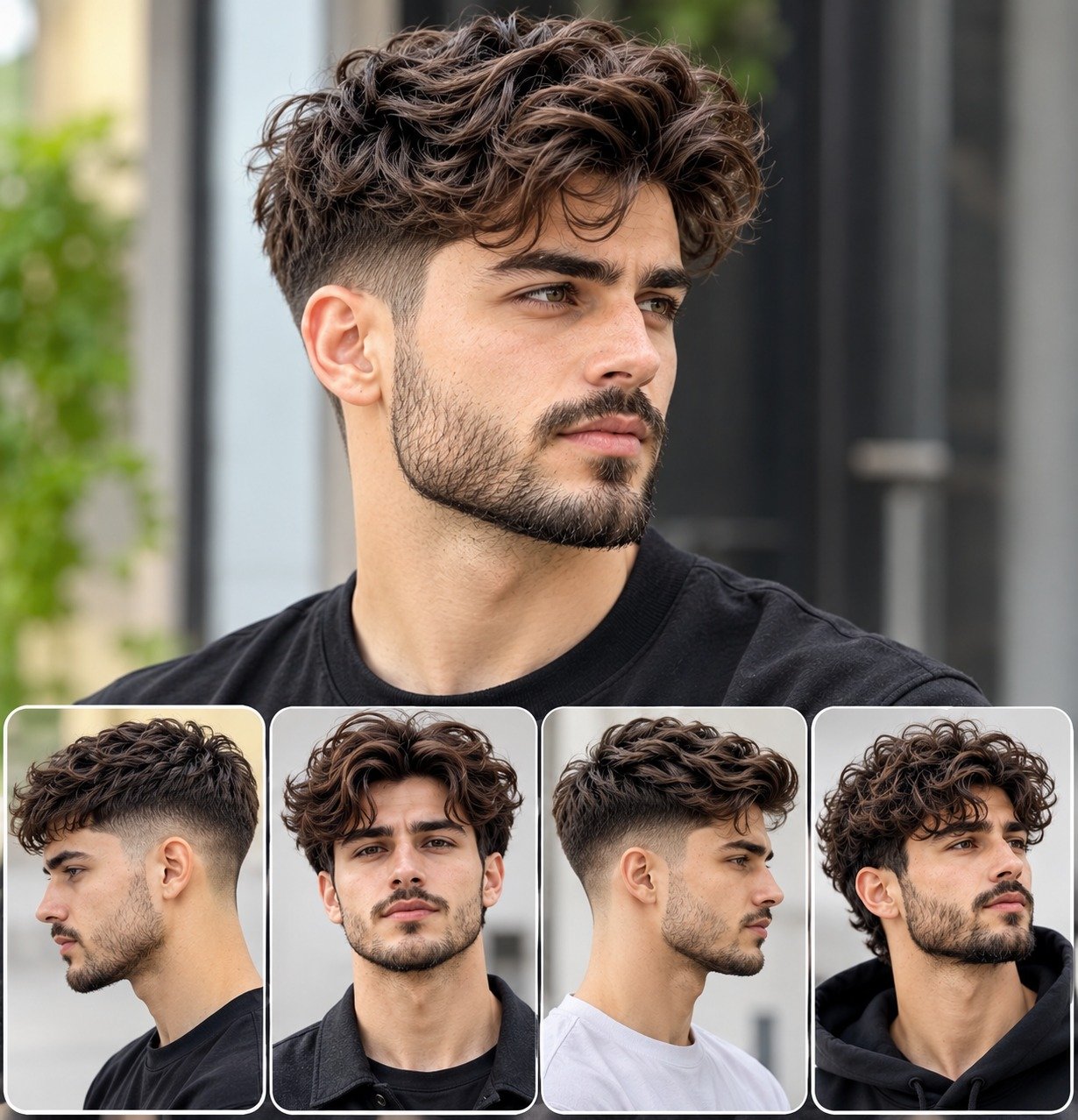
- Curly top with a taper or fade: keeps the curls on top and tidies the sides. A very popular and low-fuss option.
- Curly fringe: longer curls falling forward. Works well for oval and long face shapes.
- Short twists, waves or a high-top: styles built around natural texture, ideally cut by a barber who works with coily hair regularly.
- Low crop: a short cut that removes the need for daily styling.
Tell your barber how you normally wear your hair and ask whether they prefer to cut it wet or dry. Keep enough length on top that your curls can form.
Haircut for thinning hair for men
A haircut for thinning hair for men should reduce contrast between thick and thin areas rather than hide them.
- Short and textured: a close crop or textured crew cut makes thinning less obvious than longer hair.
- Buzz cut: one even length removes the contrast between thick and thin areas.
- Avoid long, thin top lengths: they can separate and show scalp.
- Use matte products: shiny or heavy styling products can make hair look clumped.
If you notice sudden or fast thinning, speak to a doctor or dermatologist. The AAD recommends seeing a dermatologist if you are worried about thinning hair, because most causes can be treated, and earlier is better (AAD hair care guidance).
Haircut names for men: a barber glossary
| Term | What it means |
|---|---|
| Taper | Gradual shortening at the sides and neckline, without going to skin |
| Fade | Blends from very short to longer, often to skin |
| Undercut | Short sides with a clear, disconnected length on top |
| Quiff | Front hair swept upward and back |
| Pompadour | Larger, more dramatic quiff with a lot of volume |
| Crew cut | Short sides, slightly longer top, classic and neat |
| Fringe / bangs | Hair at the front combed forward over the forehead |
| Texturizing | Cutting that removes weight and adds a choppy finish |
| Line up / edge up | Cleaning the hairline and edges with a trimmer |
How to ask your barber for the haircut you want
- Bring two or three photos. Show a front view, a side view and the back if possible. Photos beat any name.
- Use numbers and measurements. Say “mid fade with a #2 on the sides and about two inches on top.”
- Describe your hair. Mention cowlicks, thin patches and how you usually style your hair.
- Say how much time you want to spend. A barber can adjust the cut to your routine.
- Check as you go. If the sides are going shorter than you expected, say so early. Hair does not grow back quickly.
A complete request sounds like this: “Mid skin fade, #2 on the sides blending up to a #4 at the temples, about two inches on top, textured, with a natural side part.” The barber knows the exact result, and you can compare it with your reference photo.
How often should you get a haircut?
Because hair grows roughly half an inch a month, short fades and tapers look fresh for a few weeks, which is why many people book every two to four weeks. Medium and longer styles can often go six to ten weeks between trims. These are guidelines; your own growth speed and how sharp you want the cut will decide.
Between visits, you can tidy the back of the neck and the area around the ears with a trimmer. Leave fades and blending to a barber, since a self-cut fade is easy to ruin.
Common mistakes when choosing a haircut
- Copying a celebrity cut without checking your hair type. A photo of straight, thick hair will not work the same on fine or curly hair.
- Ignoring face shape. Height on top can lengthen a face that is already long.
- Forgetting maintenance. A cut you cannot keep up quickly looks untidy.
- Skipping the beard. A haircut and a beard shape work together. Try our beard style recommender or read about beard styles for your face shape.
Expert tips for a better result
- Find a barber you trust and stay with them. They learn your hair over time.
- Pick a style that works on a bad hair day, not only a good one.
- Use a small amount of product. Too much weighs down fine hair and hides a good cut.
- Think about your wardrobe too. Our AI fashion advice tool can help you check that a new cut works with your usual style.
- Glasses wearers should consider frame shape too. Try the AI glasses finder alongside your haircut choice.
Frequently asked questions
What is the best haircut for men?
There is no single best cut. The best haircut for men matches face shape, hair type and routine. A mid fade or tapered side part with some texture on top is a flexible starting point for many men.
How do I know what haircut suits me?
Work out your face shape, note your hair type, and test a few styles. Our guide to which hairstyle suits you and the hairstyle recommender can shortlist options.
Which haircut is best for a round face?
Styles with height on top and shorter sides, such as a quiff or a high fade with volume, help elongate the face. See the round face hairstyle guide.
How much hair should I leave on top?
For a style you can comb or push, leave about two inches or more. For a crew cut, about half an inch to an inch is typical. Ask your barber to start longer; they can always cut more.
Conclusion
The best haircut for men fits your face, your hair and your daily routine. Shortlist two or three styles, then try them in the Sitnit hairstyle recommender with a photo or a short quiz before you book.